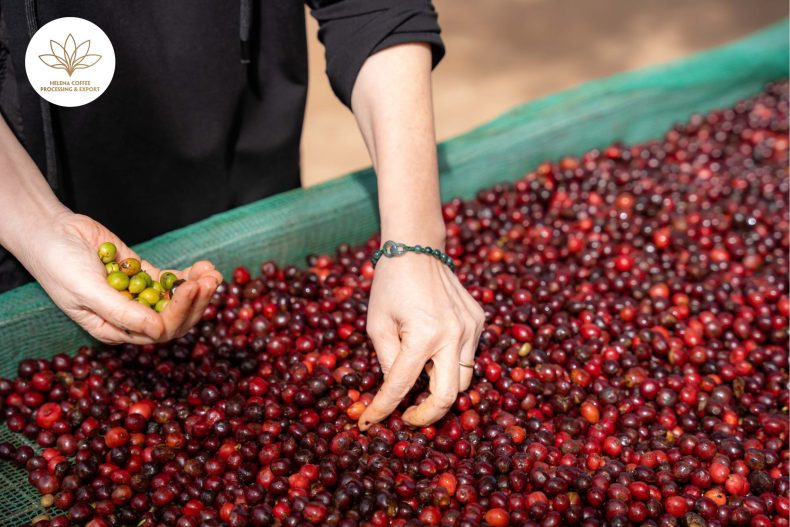
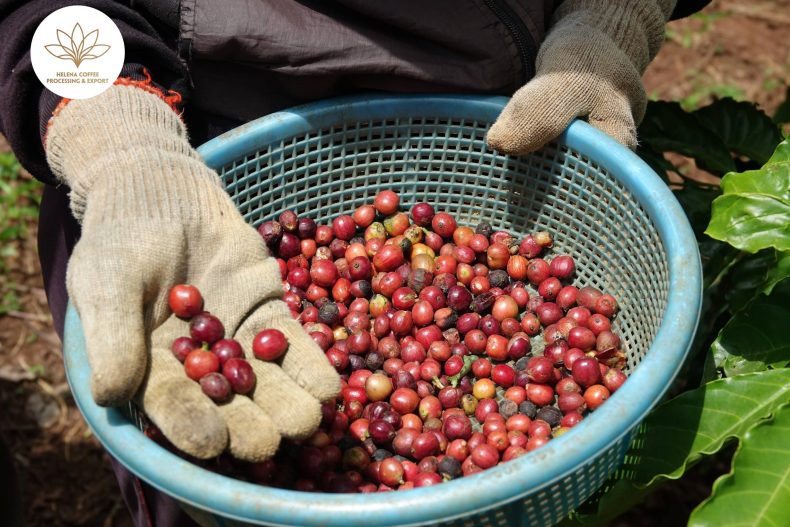
Buying Vietnam robusta coffee beans wholesale comes down to five decisions: grade and screen size, processing method, contract specifications, price basis and shipping terms. Get them right and a container from the Central Highlands is one of the most dependable purchases in green coffee. Leave them vague and you can receive a lot that matches its label on paper but not in your roaster.
This guide answers the questions importers, roasters and private-label brands ask our export team in Buon Ma Thuot most often: where the coffee grows, when to buy, how grades and processing methods compare, how pricing works, and what MOQ, payment and lead times to expect. For the wider story of how Vietnam is adding value to its crop, read Vietnamese robusta: from coffee beans to high-value products.
Key Takeaways
- USDA FAS forecasts Vietnam’s 2026/27 robusta crop at 31.4 million 60-kg bags, grown mainly in Dak Lak, Lam Dong and Gia Lai.
- The core export grades are Grade 1 screen 18, Grade 1 screen 16 and Grade 2 screen 13; your contract numbers, not the grade name, define what you receive.
- Natural (clean) robusta is the volume product; wet polished, washed, honey and fermented lots cost more and suit different uses.
- Prices follow London ICE robusta futures plus or minus a differential and are fixed in a signed PI or contract.
- A standard order is one 20 ft container (320 × 60 kg bags, 19.2 MT), FOB Ho Chi Minh City, shipped about 2–4 weeks after contract.
Table of Contents
- What Are Vietnam Robusta Coffee Beans?
- Where Is Vietnam Robusta Grown?
- When to Buy: The Robusta Crop Calendar
- Grades and Screen Sizes: G1 S18, G1 S16 and G2
- Processing Options: Natural, Wet Polished, Washed, Honey and Fermented
- How Is Vietnam Robusta Priced?
- MOQ, Containers, Incoterms, Payment and Lead Time
- How to Evaluate a Supplier and Its Samples
- How Helena Supplies Vietnam Robusta Coffee Beans
- Frequently Asked Questions
- Next Steps
[IMAGE PLACEHOLDER — replace with a real photo, then delete this line] File: dak-lak-robusta-export-bags-warehouse.webp · ALT: Vietnam robusta coffee beans packed in 60 kg jute bags at Helena’s Dak Lak warehouse · Brief: real photo of stacked export bags with visible shipping marks
What Are Vietnam Robusta Coffee Beans?
Vietnam robusta coffee beans are the green (unroasted) seeds of Coffea canephora, grown mostly in the Central Highlands. Vietnam is the world’s second-largest coffee producer and its largest robusta producer. USDA FAS forecasts 2026/27 output at 32.5 million 60-kg bags, of which 31.4 million are robusta, and exports at 28.95 million bags (Daily Coffee News, 24 June 2026).
Robusta has more caffeine and less acidity than arabica, with a heavy body and cocoa, nutty or woody notes. That makes it the backbone of espresso blends, dark roasts, Vietnamese phin coffee and instant coffee manufacturing. If your product needs bright acidity or floral aromatics, robusta is the wrong tool: it earns its place through body, crema, strength and cost per cup.
Where Is Vietnam Robusta Grown?
Most Vietnam robusta coffee beans come from three provinces, listed here under the names used since Vietnam merged its 63 provinces into 34 on 1 July 2025:
- Dak Lak, home to Buon Ma Thuot, the country’s coffee trading hub. The province also absorbed coastal Phu Yen.
- Lam Dong, which now includes former Dak Nong, a major robusta area, as well as Binh Thuan. Lam Dong also grows arabica around Da Lat and Cau Dat.
- Gia Lai, which absorbed Binh Dinh. Former Kon Tum province is now part of Quang Ngai.
For commercial grades, how a lot is dried, sorted and stored usually matters more than its province. For specialty lots, ask for the exact district, altitude and processing station.
When to Buy: The Robusta Crop Calendar
Picking usually starts in mid-to-late October, beans arrive in volume from November, and the harvest peaks from late November into December before winding down around January. Rain can delay it: StoneX estimated that by late November 2025 only 14% of the robusta crop had been harvested, against 25% historically (StoneX, 11 December 2025).
What the calendar means when you buy Vietnam robusta coffee beans:
- New crop is usually offered from about November–December, once cherries are dried, hulled and sorted. Write the crop year (for example, “2026/27 crop”) into the contract.
- Old crop keeps trading through the following year, so check the crop year on every offer.
- Weather early in the year shapes the next crop. USDA FAS noted below-normal Central Highlands rainfall in January–March 2026 and cited elevated El Niño odds through the end of 2026, so watch early-2027 conditions if you plan forward purchases.
Helena ships green coffee every month, so the harvest window mainly affects freshness, the availability of specific screens and price, not whether you can buy.
Grades and Screen Sizes: G1 S18, G1 S16 and G2
Most Vietnam robusta coffee beans are exported under a grade, a screen size and three numbers: black and broken beans (B&B, the share of black, partly black and broken beans), foreign matter (FM: stones, sticks, husk) and moisture. Typical contract values look like this:
| Grade | Screen (90% min above) | B&B max | FM max | Moisture max | Typical use |
|---|---|---|---|---|---|
| Grade 1 S18 | Screen 18 (7.1 mm) | 2% | 0.5% (0.1% on cleaned lots) | 12.5% | Whole bean, espresso, premium blends |
| Grade 1 S16 | Screen 16 (6.3 mm) | 2% | 0.5% (0.1% on cleaned lots) | 12.5% | Roast and ground, blends, crema base |
| Grade 2 S13 | Screen 13 (5.0 mm) | 5% | 1% | 13% (12.5% advisable) | Soluble extraction, price-led blends |
Vietnam’s national standard, TCVN 4193:2014, also defines Grades 1 to 3, but it limits total defective beans by mass, so its figures are not directly comparable with contract B&B limits. Our explainer on the Vietnamese coffee grading system covers the labels. The practical rule: the numbers written in your contract govern the shipment.
Two examples from our range: the robusta coffee grade 1 screen 18 lot specifies 90% min above screen 18, 2% B&B, 0.1% FM and 12.5% moisture, while the robusta coffee screen 16 grade 1 lot is cleaned to 0.1% black and 0.3% broken beans. Early in the season, ask about grade 1 robusta coffee beans new crop.
Related reading: Grade 1 vs Grade 2 Vietnamese robusta and Robusta screen 18 vs screen 16.
Processing Options: Natural, Wet Polished, Washed, Honey and Fermented
Processing changes the cup, look and price of Vietnam robusta coffee beans:
| Process | What happens | Cup and appearance | Best for |
|---|---|---|---|
| Natural (clean) | Whole cherries sun-dried, then hulled, cleaned and sorted | Full body, cocoa and woody notes | Blends, espresso, dark roasts, soluble |
| Wet polished | Natural coffee hulled, polished with water to remove the silver skin, then re-dried | Cleaner look, less chaff, even roast | Espresso, visible whole-bean retail |
| Washed (wet processed) | Cherries pulped, mucilage removed and washed before drying | Cleaner, brighter cup | Single origin, premium blends |
| Honey | Pulped, then dried with part of the mucilage left on | Sweeter, syrupy body | Specialty roasters |
| Fermented or anaerobic | Cherries fermented under controlled, low-oxygen conditions before drying | Fruit-forward, complex | Specialty and Fine Robusta programs |
Natural lots such as our robusta clean coffee beans grade 1 are the most economical choice for blends and extraction. For a cleaner look, compare vietnam wet polished robusta with robusta fully washed coffee beans. Specialty buyers usually start with vietnam robusta honey processed coffee or fine robusta anaerobic vietnam, a natural fermented anaerobic lot that scored 84.5 points under the CQI protocol.
The trade-off: processed lots cost more and come in smaller volumes. In a dark-roast blend or an extraction tower, much of the processing benefit disappears in the cup. For the specialty side, read how Vietnamese robusta is moving from volume to Fine Robusta.
[IMAGE PLACEHOLDER — replace with a real photo, then delete this line] File: robusta-processing-methods-side-by-side.webp · ALT: Natural, wet polished, washed and honey processed robusta green beans side by side · Brief: studio photo of four processing types from Helena lots, labeled
Comparing grades or processing methods? Tell us your end use (espresso blend, roast and ground or soluble) and volume. Our export team replies within 24 hours with matching lots, a dated FOB or CIF quote and a free sample. Request a Free Sample
How Is Vietnam Robusta Priced?
Wholesale robusta is priced as the London ICE robusta futures price plus or minus a differential. Futures move every trading day with global supply and demand. The differential reflects grade, screen, processing, timing, packing and shipping terms. The final price is fixed in a signed PI or contract, so any quote is valid only for a short window.
For context, London robusta futures for November 2026 traded near USD 3,470 per ton on 12 October 2026, after easing from the record highs of early 2025. Central Highlands green coffee sold at VND 92,200–93,000/kg the same day; both figures come from our daily coffee price update. Vietnam’s average export price for January–September 2026 was about USD 4,537 per ton, nearly 20% lower year on year (Ministry of Agriculture and Environment, reported by DTiNews on 4 October 2026).
What moves the differential on Vietnam robusta coffee beans:
- Quality: screen 18 trades above screen 16, which trades above Grade 2; lower B&B and processed lots carry premiums.
- Timing: new-crop arrivals, farmer selling pace and weather.
- Logistics: FOB versus CFR/CIF, special packing (GrainPro liners, jumbo bags), third-party inspection and certified-lot premiums.
Compare offers on cost per usable kilogram, not price per ton: a cheaper lot with more defects and moisture can cost more per cup. Every quote is dated and confirmed in a PI; for natural lots, start with our robusta green coffee beans wholesale price page or the coffee price today hub.
MOQ, Containers, Incoterms, Payment and Lead Time
Our standard terms for green robusta are below; payment is agreed case by case for established buyers.
| Term | What to expect |
|---|---|
| MOQ | From 1 MT; the standard green-coffee shipment is one 20 ft container |
| Container load | 20 ft: 19.2 MT (320 × 60 kg jute or PP bags); 40 ft: about 26–27 MT, subject to weight limits |
| Packing options | GrainPro or hermetic liners and 1,000 kg jumbo bags on request; kraft paper lining and desiccants as standard |
| Incoterms | FOB Ho Chi Minh City (Cat Lai port) standard; CFR or CIF on request; EXW Buon Ma Thuot for some products |
| Payment | 30% T/T deposit and 70% against copy of B/L, or irrevocable L/C at sight |
| Lead time | About 2–4 weeks from signed PI or contract, depending on season and queue |
| Documents | Commercial invoice, packing list, B/L, C/O, ICO certificate of origin, phytosanitary and fumigation certificates, COA |
Inspection by SGS, Cotecna, Cafecontrol or Vinacontrol can be arranged on request. If trade terms are new to you, the ICC’s Incoterms rules define where cost and risk pass from seller to buyer.
EU buyers: as of October 2026, EUDR obligations apply from 30 December 2026 for large and medium operators and from 30 June 2027 for micro and small operators (Regulation (EU) 2025/2650). Vietnam is classified low risk, which allows simplified due diligence, but plot geolocation is still required. Agree early how your supplier will provide it.
How to Evaluate a Supplier and Its Samples
Before you commit to Vietnam robusta coffee beans from any exporter, work through these steps:
- Cup and grade a sample. Qualified buyers receive free cupping samples (typically about 100 g per profile); ask for more if you want to run your own moisture, screen and defect checks.
- Approve a pre-shipment sample (PSS) drawn from the actual lot before loading, and keep a sealed counter-sample.
- Check the documents: the ICO certificate of origin, phytosanitary certificate and certificate of analysis should match the contract.
- Verify certificates: ask for the certificate number and scope behind every food-safety or sustainability claim, and confirm them with the issuing body.
- Visit if you can. Buon Ma Thuot is about a one-hour flight from Ho Chi Minh City.
Red flags include “export quality” with no numbers, no crop year, “0% defects”, refusal of a PSS or independent inspection, and certification logos without certificate numbers. Our guides to robusta coffee specifications and reading a robusta spec sheet go line by line.
How Helena Supplies Vietnam Robusta Coffee Beans
Helena Coffee was founded in Buon Ma Thuot in 2016. Our Dak Lak mill handles up to 100 tons a day on sorting, grading and packing lines that include optical color sorting, and our annual robusta export capacity exceeds 10,000 tons. Coffee comes from a network of around 500 partner farmers and 2,200 coffee pickers, and we ship to buyers in 55+ countries.
For your order, that means lots are color-sorted and moisture-checked before stuffing, and the PSS is drawn from the bags you will receive. Helena is ISO 22000:2018 and HACCP certified, Halal-certified and operates an FDA-registered facility. We also train partner farmers in good agricultural practices through our sustainability program, and buyers are welcome to visit our mill and farms.
We are not the right fit for every buyer. If you need a few bags delivered to your roastery door, a local green-coffee importer will serve you better; we work from 1 MT up to full containers.
[IMAGE PLACEHOLDER — replace with a real photo, then delete this line] File: dak-lak-optical-color-sorter-robusta.webp · ALT: Optical color sorter grading robusta green beans at Helena’s Dak Lak mill · Brief: real photo of the sorting line in operation
Frequently Asked Questions
Which grade of Vietnam robusta is best for espresso?
Most espresso roasters choose Grade 1 screen 18 or screen 16 with B&B at 2% or lower, because uniform beans roast evenly and low defects keep harsh notes out of the cup. Wet polished or honey lots add a cleaner, sweeter profile at a higher price. Grade 2 is better suited to dark roasts and extraction.
How many tons of Vietnam robusta coffee beans fit in a container?
A 20 ft container holds 19.2 MT: 320 bags of 60 kg in jute or PP. A 40 ft container carries about 26–27 MT, subject to road and shipping-line weight limits. If you use 1,000 kg jumbo bags or hermetic liners, confirm the net load with our team before booking.
How long do green robusta beans stay fresh?
Green coffee is best used within about 12 months of shipment if it is stored cool and dry, away from strong odors. Hermetic liners help on long voyages and in humid warehouses. Ask for the crop year on every offer and see our guide to green coffee storage for warehouse practice.
Can I order less than a full container?
Yes. Our MOQ starts from 1 MT, and smaller volumes can be combined with other grades in a mixed container, with bags marked separately and one set of documents. A full 20 ft container is still the most cost-efficient unit for freight and paperwork, so compare the landed cost per kilogram of both options.
Next Steps
Start with your end use and annual volume, then shortlist two or three grade and processing combinations to cup side by side. Send us those details and we will match current lots, quote FOB Ho Chi Minh City or CIF to your port, and ship samples so you can buy Vietnam robusta coffee beans on evidence, not on labels.
Ready to source Vietnam robusta? Tell us your grade, screen, volume and destination port. Our export team replies within 24 hours with a dated quote and a free sample. Request a Quote or WhatsApp +84 789 818 828.