Private label coffee from Vietnam follows a predictable sequence: brief, format, samples, costing, artwork, printing cylinders, pilot approval, production, quality control, documents and shipping. With a private label coffee manufacturer in Vietnam, most first orders ship about 20–30 days after artwork approval, and later when new printing cylinders have to be engraved.
This guide follows each step as we run it at Helena Coffee Vietnam in Buon Ma Thuot, Dak Lak: what you decide, what we need from you, where MOQs and costs come from, and which compliance questions catch first-time brand owners. Customization choices (blend ratios, mix recipes, packaging materials) are covered in our guide to OEM coffee in Vietnam.
Key Takeaways
- Timeline: about 20–30 days of production after artwork approval; first orders needing new cylinders take longer than repeats.
- MOQs come from packaging: printed film runs are typically 250,000–420,000 sachets per design; roasted private label starts at 500 kg, instant bulk at 1 MT.
- Compliance is the brand owner’s job: EU, US, GCC and EAEU labels differ on language, dates and nutrition panels.
- Write it down: a quality agreement with specs, tolerances, retained samples and change control protects every batch.
- Payment: a T/T deposit covering film, cylinders and materials plus the balance before B/L release, or an L/C at sight.
Table of Contents
- What Does a Private Label Coffee Manufacturer in Vietnam Do?
- Step 1: Write a Brief the Factory Can Quote
- Step 2: Choose the Product and Format
- Step 3: Samples, R&D and the Golden Sample
- Step 4: How Private Label Pricing Is Built
- Steps 5–6: Artwork, Printing Cylinders and Film Minimums
- Step 7: Check Label Rules in Every Market
- Steps 8–9: Pilot Approval, Production and Quality Control
- Steps 10–11: Documents, Payment and Shipping
- Protect Your Brand: IP and the Quality Agreement
- Frequently Asked Questions
- Next Steps
[IMAGE PLACEHOLDER — replace with a real photo, then delete this line] File: private-label-instant-coffee-sticks-export-cartons.webp · ALT: Private label instant coffee sticks packed into export cartons in Vietnam · Brief: real photo of a Helena OEM packing run; confirm location before captioning
What Does a Private Label Coffee Manufacturer in Vietnam Do?
A private label coffee manufacturer produces coffee to an agreed specification and packs it under your brand. In Vietnam that usually means sourcing robusta and arabica at origin, turning it into instant coffee, mixes or roasted coffee, filling your printed packaging, testing each lot and shipping export-ready cartons with documents.
You keep the brand, the artwork and the customer relationships. Because Vietnam is the world’s largest robusta producer, the coffee for instant and roasted blends is bought at origin rather than through intermediaries.
Private label is not always the right model. If your yearly volume is below one printed-film run, or you prefer to pack in your own country, buying instant coffee in bulk can make more sense; our notes on choosing bulk instant coffee suppliers cover that route.
Step 1: Write a Brief the Factory Can Quote
A complete brief gets an accurate quote in one round instead of five. Include:
- Target markets and channel (retail, e-commerce, HoReCa, vending)
- Format and pack sizes, for example 16 g 3-in-1 sticks or 100 g jars
- A reference product you want to match or beat on taste
- Target retail price or landed cost per unit
- Expected volume for the first order and the first year
- Certificates and label languages your customers require
- Destination port and preferred Incoterm
Step 2: Choose the Product and Format
Format decides your cost structure, MOQ and shelf life more than any other choice.
| Format | Best for | Specs to fix | What sets the MOQ | Shelf life (sealed) |
|---|---|---|---|---|
| Spray-dried instant | Value retail, vending, food service | Moisture ≤5%, solubility ≥98%, strength | Bulk from 1 MT; retail packs by film run | 24 months |
| Freeze-dried instant | Premium jars and sticks | Moisture ≤4%, granule look, aroma | Jar or stick packaging run | 24 months |
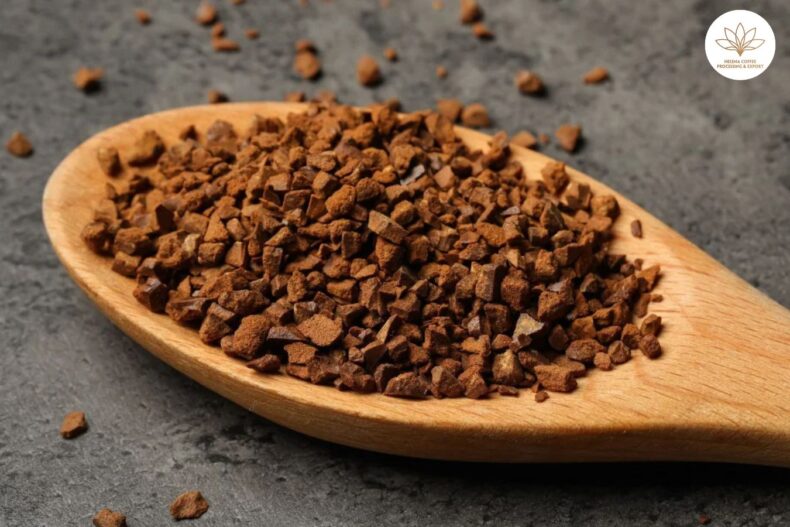
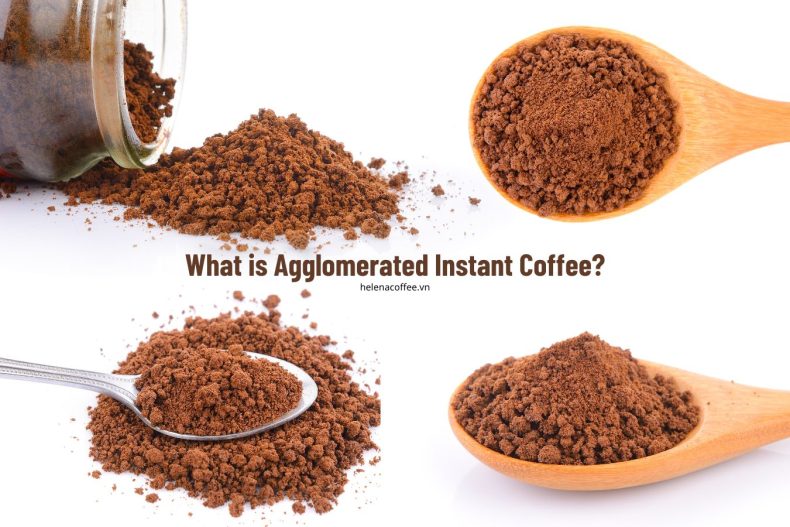
| Agglomerated instant | Granular jar products below freeze-dried cost | Granule size, solubility | Packaging run | 24 months |
| 2-in-1, 3-in-1, 4-in-1 mixes | Mass retail, offices, gifting | Coffee, sugar and creamer ratio; stick weight | Film minimum per design | Confirm per formula |
| Roasted whole bean or ground | Cafés, specialty and retail bags | Blend ratio, roast level, grind | 500 kg for private label | About 12 months bean, 6 months ground |
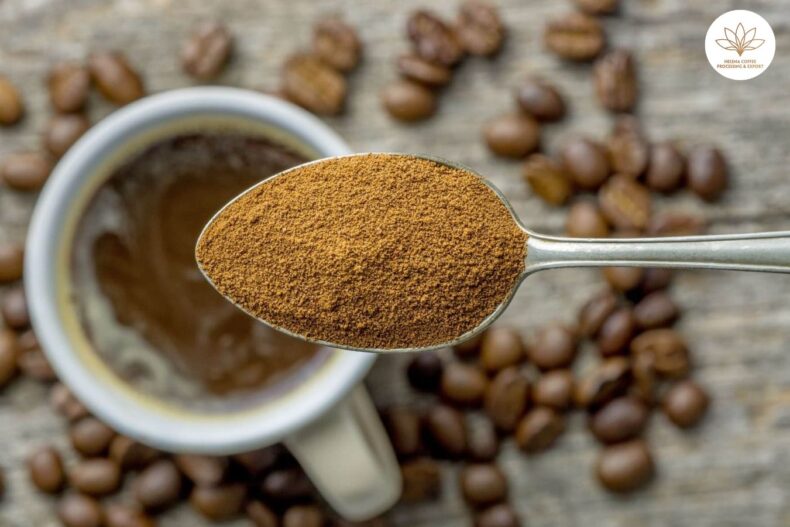
For instant, common bases are spray dried instant robusta grade 1, the premium spray dried fine robusta instant coffee, a freeze dried instant coffee blend or agglomerated instant coffee (AI01). Mixes start from light, strong, coconut, cappuccino, salted coffee and durian 4-in-1 profiles. Roasted blends run from 100% robusta to 30/70 robusta–arabica.
Step 3: Samples, R&D and the Golden Sample
- Free samples for qualified buyers: typically 200–500 g per instant SKU, enough for lab tests and a tasting panel, sent on your DHL or FedEx account or quoted in advance.
- Iterations: standard profiles adjust quickly. Stevia or low-sugar mixes are custom R&D and need extra trial rounds.
- Lock the standard: give the approved sample a reference code. This “golden sample” becomes the benchmark for every production lot on taste, moisture and solubility.
Step 4: How Private Label Pricing Is Built
We do not publish private label prices, because every quote is built from your choices. Knowing the components helps you compare offers fairly:
- Coffee base: tracks the London robusta and New York arabica futures markets, so quotes carry a validity date.
- Other ingredients: sugar and creamer prices; low-sugar recipes change the bill of materials.
- Packaging materials: film structure, pack size, cartons and pallets.
- Printing cylinders: gravure film needs one engraved cylinder per color. It is a one-off cost per design, reused on repeat orders.
- Order size: setup costs spread over more units, so unit cost falls as volume rises.
- Terms: Incoterm (FOB Ho Chi Minh City is standard), extra testing or inspection, and payment method.
This is why a first order costs more per unit than a repeat, and why an offer of “free cylinders” usually recovers that cost elsewhere in the price.
Planning your first private label run? Send us your format, market and volumes. Our export team replies within 24 hours with a costed proposal and free samples for qualified buyers. Request a Quote
Steps 5–6: Artwork, Printing Cylinders and Film Minimums
- Dielines first: we send the technical template for each pack; your designer returns print-ready vector files with Pantone references for brand colors.
- Two approvals before engraving: a digital proof for layout and copy, then a color proof. Errors found later cost time and money.
- Colors drive tooling: each color is a separate cylinder, so fewer colors cost less and a later text change means re-engraving only that color’s cylinder. If several SKUs share identical layers, ask whether those cylinders can be shared.
- Film minimums: film prints in runs of typically 250,000–420,000 sachets per design. Three flavors means three minimums, so launch with the SKUs you are sure of.
[IMAGE PLACEHOLDER — replace with a real photo, then delete this line] File: private-label-coffee-artwork-proof-gravure-cylinder.webp · ALT: Artwork color proof checked against an engraved gravure cylinder for private label coffee sachets · Brief: real photo of a proof approval or cylinder at the film printer
Step 7: Check Label Rules in Every Market
Under EU law, the business under whose name the food is marketed, or the importer if that business is outside the EU, is responsible for the label. This summary reflects the rules as of October 2026; have your importer or a regulatory adviser check the final artwork.
| Market | Main rules | Language | Points that matter for coffee |
|---|---|---|---|
| EU | Regulation (EU) No 1169/2011 | Official language of each country of sale | Name, ingredients with allergens highlighted, net quantity, best-before, storage, EU operator’s name and address; plain coffee is exempt from the nutrition table, 3-in-1 mixes are not |
| USA | FDA labeling rules (21 CFR 101) | English | Statement of identity, net quantity in metric and US units, ingredients, allergens such as milk, “Distributed by” name and address, Nutrition Facts (plain unsweetened instant is exempt), country of origin |
| GCC (e.g., Saudi Arabia) | GSO 9/2022 | Arabic, or an Arabic translation | Product name, packer, country of origin, ingredients by predominance, shelf life; importers often ask for a Halal certificate |
| EAEU (Russia, Kazakhstan and others) | TR CU 022/2011 labeling, TR CU 021/2011 safety | Russian, plus state languages where required | Composition, net quantity, date of manufacture, shelf life, storage, manufacturer and importer details, nutritional value, EAC mark |
Two details often catch brand owners out. In the EU, mandatory text needs an x-height of at least 1.2 mm, or 0.9 mm on packs whose largest surface is under 80 cm² (FSAI summary of EU labelling rules). In the US, if any foreign language appears on the label, every required statement must appear in both English and that language (FDA Food Labeling Guide).
For the Gulf, the trade.gov summary of Saudi labeling rules is a useful checklist. For Russia and the EAEU, our team has handled GOST 32776-2014 (instant coffee) and TR CU 021/2011 requirements. EU buyers should also note the deforestation regulation (EUDR): from 30 December 2026 it applies to green and roasted coffee for large and medium operators, while a Commission draft of May 2026 proposes adding instant coffee.
Steps 8–9: Pilot Approval, Production and Quality Control
Before full production, the first printed reels and filled packs are checked against the approved proof and golden sample: print, seal, fill weight and taste. You approve photos or a pre-production sample. Production then runs about 20–30 days from artwork approval; repeats with existing cylinders move faster, and bulk instant without printed packs takes roughly 15–20 working days.
A sound quality plan for private label covers:
- Incoming checks on coffee, sugar, creamer and packaging film
- In-line checks on fill weight, seal integrity and lot and date coding
- Finished-product tests on every lot (moisture, solubility and taste for instant) with a certificate of analysis (COA)
- Retained samples from each lot, kept at least through shelf life, so any complaint can be traced and retested
Helena works under ISO 22000:2018 and HACCP food safety systems, is Halal-certified and is an FDA-registered facility. Ask us for current certificate copies with scope and expiry dates.
Steps 10–11: Documents, Payment and Shipping
- Documents: commercial invoice, packing list, bill of lading, certificate of origin, COA and health certificate, plus market-specific papers; third-party inspection on request.
- Payment: a T/T deposit covering packaging film, cylinders and materials, with the balance before B/L release, or an irrevocable L/C at sight. Established buyers can discuss other terms case by case.
- Shipping: FOB Ho Chi Minh City (Cat Lai port) is standard; CFR and CIF on request. A 20 ft container holds roughly 4.5–5.5 MT of 15 g sachet product in retail cartons, or about 6 MT of bulk instant (about 12 MT in a 40 ft). Instant is light, so containers fill by volume before weight.
| Stage | Typical time | What keeps it moving |
|---|---|---|
| Inquiry to first reply | Within 24 hours | A complete brief |
| Samples and R&D | Courier time plus your evaluation | Fast feedback; custom recipes need extra rounds |
| Artwork and proofs | Depends on your designer | Approve proofs before engraving |
| Production after artwork approval | About 20–30 days | Existing cylinders on repeat orders |
| Ocean transit | e.g., about 22–28 days to Jeddah | Forwarder confirms other routes |
Protect Your Brand: IP and the Quality Agreement
Before you sign with any private label coffee manufacturer in Vietnam, put these points in writing. Intellectual property:
- You own your trademark and artwork files. Register the mark in each sales market before printing; WIPO’s Madrid System lets one application extend to many member countries.
- Agree in writing who pays for and owns the printing cylinders, where they are stored and that they will not be used for anyone else.
- If a recipe is developed for you, state whether it is exclusive to your brand.
A quality agreement should cover:
- Specification and tolerances: moisture, solubility, fill weight and the golden sample as the sensory standard
- Test methods and a COA for each lot
- Lot coding, traceability and retained samples
- Change control: no change to coffee origin, ingredients or packaging structure without written approval
- Complaint handling, claim time limits and recall cooperation
Related reading: Building a private label coffee brand: a sourcing checklist and how to order wholesale coffee beans from Vietnam.
Frequently Asked Questions
What is the minimum order for private label coffee in Vietnam?
For printed sachets and sticks, the film sets the minimum: typically 250,000–420,000 sachets per design. Roasted private label starts at 500 kg, and instant coffee in bulk at 1 MT. If your volume is below one film run, consider bulk instant packed locally, or launch with fewer SKUs.
How long does a first private label coffee order take?
Allow about 20–30 days of production after artwork approval, plus time for samples, proofs and ocean transit. First orders take longer because printing cylinders must be engraved; repeats are faster. Ask for a dated plan at the quote stage so every approval has a deadline.
Can I visit Helena before placing an order?
Yes. Buyers are welcome at our Dak Lak mill, and Buon Ma Thuot is about an hour’s flight from Ho Chi Minh City. A visit lets you see the sorting and packing lines, meet the team and taste samples. Arrange it through our factory visit page, or ask about a video call if travel is not possible.
Which certifications does Helena hold?
Helena is ISO 22000:2018 and HACCP certified, Halal-certified and an FDA-registered facility. FDA registration is a listing, not an approval. If your retail customers require other schemes, tell us at the brief stage so we can confirm what our current certification covers before development starts.
Next Steps
Choosing a private label coffee manufacturer in Vietnam starts with a one-page brief: market, format, pack sizes, volumes and target cost. We reply within 24 hours, then build the sample plan and production timeline with you.
Ready to brief us? Tell us your market, format and volumes, and our export team will reply within 24 hours with next steps and free samples for qualified buyers. Request a Quote or WhatsApp +84 789 818 828.