OEM coffee in Vietnam means a factory produces coffee to your recipe, fills your packaging and ships it under your brand. The levers you control are the formula (bean base, blend ratio, roast profile or 3-in-1 recipe), the packaging format and material, the artwork, and the certificates and documents that travel with each lot. Each lever changes taste, shelf life, minimum order or cost, and some change all four.
Our pillar guide to working with a private label coffee manufacturer in Vietnam covers the process step by step. This guide covers the choices themselves, as we handle them in OEM projects at Helena Coffee Vietnam in Dak Lak.
Key Takeaways
- Three models: white label relabels a finished product, private label puts your brand on the factory’s recipe, OEM builds recipe and packaging around your brief. Setup cost rises in that order.
- Formula levers: bean base and grade, robusta–arabica ratio (roasted blends from 100/0 to 30/70), roast level and grind, and the coffee–sugar–creamer ratio of mixes.
- Packaging sets the MOQ: printed film runs, jar and label quantities and barrier materials decide minimums and shelf life.
- Certificates to request: ISO 22000, HACCP, Halal and FDA food facility registration, each with scope, number and expiry date.
- Cost drivers: coffee market level, ingredients, drying method, film structure, print colors, order size and trade terms.
Table of Contents
- OEM vs Private Label vs White Label: What Is the Difference?
- Formulation Levers: Bean Base, Blend Ratio and Roast Profile
- Packaging Formats and Materials: What Changes Cost and Shelf Life
- Branding and Artwork: What You Own and What We Need
- What Certifications Should an OEM Coffee in Vietnam Partner Hold?
- What Drives OEM Coffee Costs?
- OEM Decision Checklist
- Frequently Asked Questions
- Next Steps
[IMAGE PLACEHOLDER — replace with a real photo, then delete this line] File: oem-coffee-formats-sachets-jars-roasted-bags.webp · ALT: Instant coffee sticks, glass jars and roasted coffee bags prepared for an OEM packaging review in Vietnam · Brief: real photo of a Helena OEM format line-up on a meeting table
OEM vs Private Label vs White Label: What Is the Difference?
OEM (original equipment manufacturer) coffee is made to the buyer’s own specification: recipe, packaging and brand are all yours. Private label uses the factory’s existing recipe under your brand. White label is a finished, generic product that several brands sell with their own label. The more you customize, the longer development takes and the higher the one-off setup cost.
| Model | Who owns the recipe | Packaging | Development time | Best for |
|---|---|---|---|---|
| White label | Factory (shared product) | Standard pack, your label | Shortest | Market tests, small ranges |
| Private label | Factory standard, your brand | Your artwork on standard formats | Short to medium | Retail and e-commerce brands |
| OEM | You (built to your brief) | Your format, material and artwork | Longest | Brands with a defined taste or claim |
In practice the lines blur. Most OEM projects we handle start from a standard base, such as spray dried instant robusta grade 1 or the premium spray dried fine robusta instant coffee, and customize from there: cheaper and faster than a recipe built from zero, and still specific to your brand.
Formulation Levers: Bean Base, Blend Ratio and Roast Profile
The coffee base
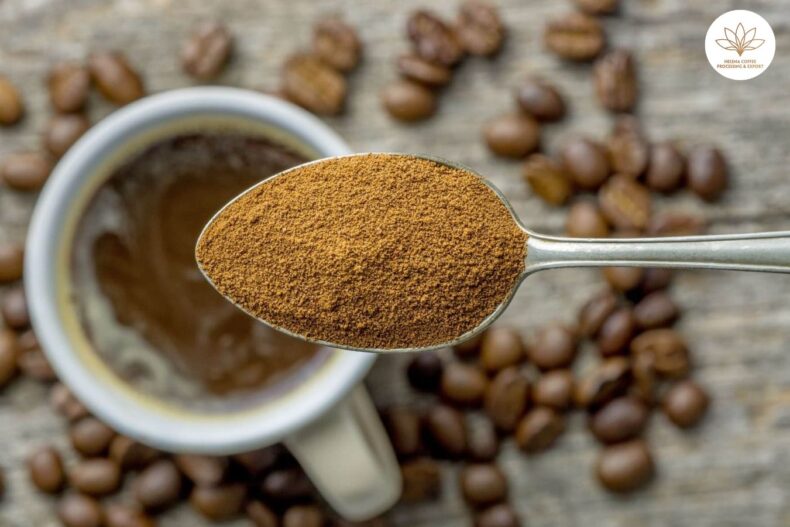
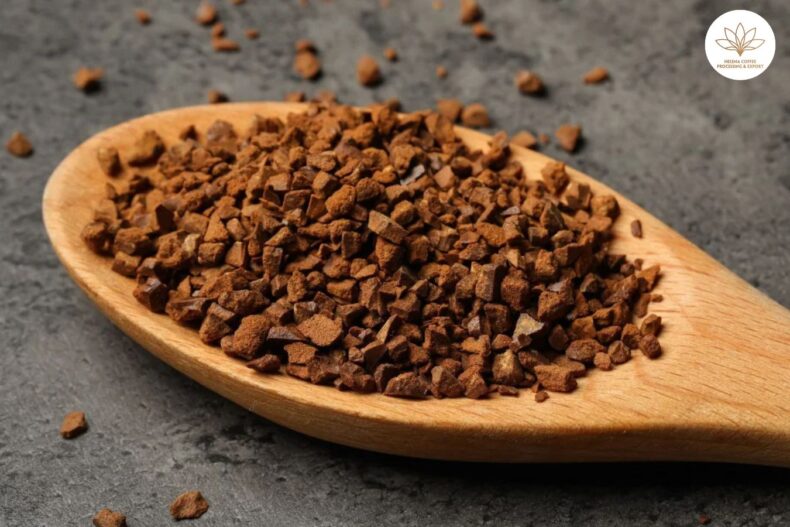
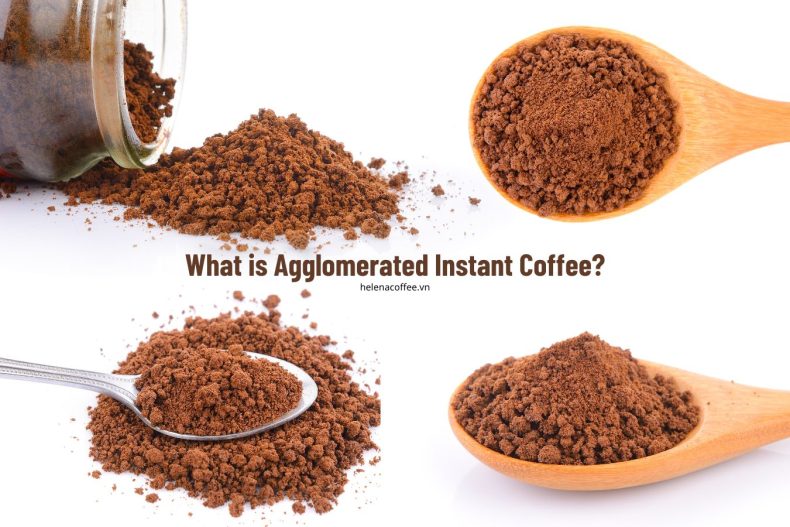
For instant coffee the first choice is the raw material: robusta grade 2, grade 1 or Fine Robusta, a robusta–arabica blend, or 100% arabica. Our robusta arabica instant coffee SD05 is the custom-ratio blend for buyers who want arabica aroma without arabica-only cost. The second choice is the drying method: spray-dried powder, agglomerated or freeze-dried granules, in rising order of cost.
Blend ratios for roasted coffee
Our roasted range runs from Traditional (100% robusta) through House Blend 90/10, Café Blend 80/20, Classic 70/30, Balanced 50/50 and Espresso 40/60 to Premium 30/70 robusta–arabica. Moving toward arabica adds acidity and aroma and raises cost; moving toward robusta adds body, bitterness and crema. Our dictionary entry on blending covers the logic.
Roast level and grind
Roast levels run from light to dark or to a custom curve; see our roast profile basics entry. Grind is also a packaging decision: sealed whole beans keep for about 12 months, ground coffee about 6 months, so ground products need a stronger barrier and a one-way valve.
2-in-1, 3-in-1 and 4-in-1 recipes
Mix recipes have four levers: the coffee–sugar–creamer ratio, coffee strength (our standard profiles are light and strong), flavor (coconut, cappuccino, salted coffee and durian 4-in-1 are standard) and stick weight, typically 16 g for 3-in-1. Standard formulas use sugar; stevia or low-sugar versions are custom R&D with extra trial rounds. Our guide to 3-in-1 coffee OEM formulation goes deeper.
What you should not change
In the EU, Directive 1999/4/EC on coffee extracts reserves the names “soluble coffee” and “instant coffee” for products made only from substances derived from coffee extraction, with a minimum coffee-based dry matter content (95% for dried extract). Fillers such as maltodextrin make it a different product with a different name, so keep them for mixes, where the label declares them.
Packaging Formats and Materials: What Changes Cost and Shelf Life
Packaging decides your minimum order, your freight cost per unit and how long the product stays fresh. The table lists the formats we offer for OEM instant and roasted coffee.
| Format | Sizes we offer | Material | Shelf life (sealed) | What sets the MOQ |
|---|---|---|---|---|
| Sachets and sticks | 2 g freeze-dried sticks, 16 g 3-in-1 sticks, custom | Laminate with aluminum or metallized barrier | Instant 24 months | Film run per design (typically 250,000–420,000 sachets) |
| Glass jars | 50 g, 80 g, 100 g, 150 g, 200 g | Glass, lid, induction seal, label | Instant 24 months | Jar and label quantity |
| Tins | Custom | Metal body and lid | Instant 24 months | Tin quantity |
| Roasted bags | Custom | Laminate with one-way valve | Beans about 12 months, ground about 6 | 500 kg for private label |
| Bulk | 25 kg kraft bags or cartons with PE liner | Kraft, PE | Instant 24 months | 1 MT |
Freight follows format: a 20 ft container holds about 6 MT of bulk instant but only around 4.5–5.5 MT of 15 g sachet product, and glass adds weight and breakage risk. Our explainer on custom coffee packaging options compares materials and barriers in detail.
Branding and Artwork: What You Own and What We Need
Branding on OEM coffee has a technical side that decides cost and timing:
- Brand assets: vector logo, Pantone references for brand colors, fonts and the claims you intend to print.
- Mandatory label content: product name, ingredients, net weight, best-before date, origin and the responsible company differ by market; the pillar guide carries a market-by-market table. Your importer or regulatory adviser signs off the final artwork.
- Color count: gravure film printing needs one engraved cylinder per color, so six colors cost more tooling than four, and a later text change means re-engraving only that cylinder. If several SKUs share a background, ask whether cylinders can be shared.
- Ownership: your trademark and artwork files stay yours. Agree in writing who pays for and owns the cylinders and that they serve your brand only.
[IMAGE PLACEHOLDER — replace with a real photo, then delete this line] File: oem-coffee-artwork-pantone-proof-review.webp · ALT: Designer checking Pantone references on an OEM coffee sachet artwork proof · Brief: real photo of a proof approval session
Have a recipe or a reference product in mind? Send us your target market, format and volumes. Our export team replies within 24 hours with a costed proposal and free samples for qualified buyers. Request a Quote
What Certifications Should an OEM Coffee in Vietnam Partner Hold?
At minimum, a food safety management certificate (ISO 22000 or equivalent), a HACCP plan that covers your product, and the registrations your market requires: FDA food facility registration for the United States and Halal certification for Muslim-majority markets. Ask for copies, then check scope, certificate number, issuing body and expiry date yourself.
| Certificate or registration | What it covers | What to check | Helena |
|---|---|---|---|
| ISO 22000:2018 | Food safety management system across the site | Scope lists the products and site you buy from; expiry date | Certified |
| HACCP | Hazard analysis and critical control points | The plan covers your format (instant, mix, roasted) | Certified |
| Halal | Ingredients (creamer in mixes), process and handling | Issuing body recognized in your destination market | Halal-certified |
| FDA food facility registration | Listing required to export food to the US | Registration number; renewal every even-numbered year, 1 October to 31 December | FDA-registered facility |
FDA registration is a listing, not an approval, and the FDA renewal guide confirms that lapsed registrations expire. Claims such as organic, Fairtrade or Rainforest Alliance need a valid certificate with scope and number; buyers should ask which certified lots exist for the current crop rather than rely on logos on a website.
What Drives OEM Coffee Costs?
We do not publish OEM prices because each quote is built from your choices, but the components are the same in every offer:
- Coffee base: priced against the London robusta and New York arabica markets, so quotes carry a validity date. Grade and drying method move it most.
- Other ingredients: sugar, creamer and flavors in mixes; low-sugar sweeteners cost more per stick.
- Packaging material: film structure, jar glass, tins, cartons and pallets. Small sticks use more film per gram of coffee than jars or bulk.
- Printing cylinders: a one-off cost per design and color, reused on repeat orders.
- Order size: setup, changeover and testing spread over more units.
- Terms: Incoterm (FOB Ho Chi Minh City is standard), inspection and payment method.
OEM Decision Checklist
Before you brief any OEM coffee in Vietnam supplier, settle these points:
- Target market, channel and the retail price the product must hit
- Taste reference: a competitor product, or a base SKU from our range
- Format and pack size, matched to how your customers brew
- Mix ratio and sweetener type for 2-in-1, 3-in-1 or 4-in-1
- Label language and claims checked against your market’s rules
- Number of print colors and SKUs for the first run
- Certificates your retailers will ask to see
- Who owns recipe, artwork and cylinders, in writing
Frequently Asked Questions
Can I start OEM coffee with a small volume?
Yes, if you choose the format carefully. Bulk instant starts at 1 MT and roasted private label at 500 kg. Printed sachets are different: film runs are typically 250,000–420,000 sachets per design, so many brands launch with one or two stick SKUs, or with jars and labels, and add sachets once volumes are proven.
Does OEM coffee from Vietnam have to be robusta?
No. Vietnam is the largest robusta producer, and robusta gives mixes and espresso-style products their strength and crema, but we also produce 100% arabica instant, custom-ratio blends such as SD05, and roasted blends up to 30/70 robusta–arabica. The ratio is a formula lever you control.
Who owns the recipe and the printing cylinders?
That depends on your contract, so put it in writing. Standard bases remain the factory’s products; a recipe developed and paid for by you can be made exclusive to your brand. Cylinders are usually paid for through the first-order deposit; the agreement should state who owns them, where they are stored and that they serve your brand only.
How long does OEM development take before the first shipment?
Count three phases: samples and recipe iterations, artwork and proof approval, then production of about 20–30 days after artwork approval for packed products, or around 15–20 working days for bulk instant. First orders with new cylinders take longer than repeats; ask for a dated plan at quotation.
Next Steps
OEM coffee in Vietnam rewards buyers who arrive with a clear brief: market, taste reference, format, mix ratio, label rules and first-year volumes. With those, we can propose a base SKU, a packaging structure and a sample plan in one round.
Ready to build your product? Send us your brief or a reference sample. Our export team replies within 24 hours with a formula proposal, packaging options and free samples for qualified buyers. Request a Quote or WhatsApp +84 789 818 828.