The Vietnam coffee industry 2026 story comes down to one contrast: record volumes at lower prices. Vietnam shipped roughly 1.4–1.5 million tonnes of coffee in January–September 2026, about 15–16% more than a year earlier, yet earned around 7% less as average export prices fell by close to 20% (VICOFA and the Ministry of Agriculture and Environment, 4 October 2026).
For importers, roasters and private-label buyers, that shift matters more than any single day’s price. Below: the 2026/27 crop, the price cycle, Brazil, value-added trends, EUDR, El Niño and a buyer playbook. All prices are in US dollars unless noted.
Key Takeaways
- Record supply: USDA forecasts Vietnam’s 2026/27 crop at 32.5 million 60-kg bags, 31.4 million of them robusta.
- Prices have eased, not collapsed: London robusta traded near $3,470/t in mid-October 2026, about 40% below its February 2025 peak but well above the $2,500/t end-2026 median of a March Reuters poll.
- Robusta is tighter than the headlines: the record world crop is mostly Brazilian arabica, and USDA sees world robusta output slightly lower in 2026/27.
- Two dates to plan around: EUDR applies to large and medium operators from 30 December 2026, and NOAA expects a strong-to-very strong El Niño through January–March 2027.
- Buyer playbook: layer forward cover, separate differential and futures decisions, diversify grades and secure EUDR data now.
Table of Contents
- How Big Is Vietnam’s 2026/27 Coffee Crop?
- Prices: From Record Highs to a Softer 2026
- Where Value and Demand Are Moving
- EUDR From 30 December 2026: What Changes for Buyers
- El Niño and Climate Risk for the 2026/27 Season
- Vietnam Coffee Industry 2026 Outlook: What Should Buyers Do?
- Frequently Asked Questions
- Next Steps
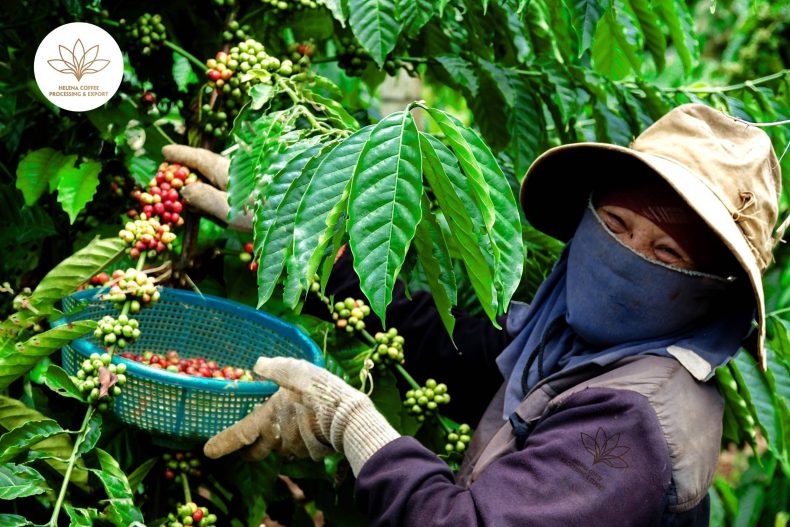
[IMAGE PLACEHOLDER — replace with a real photo, then delete this line] File: dak-lak-robusta-harvest-2026.webp · ALT: Farmers picking ripe robusta cherries in Dak Lak at the start of the 2026/27 harvest · Brief: real photo from Helena’s partner farms during harvest
How Big Is Vietnam’s 2026/27 Coffee Crop?
Vietnam’s 2026/27 coffee crop is forecast at a record 32.5 million 60-kg bags, up 2.5%, according to the USDA Foreign Agricultural Service (June 2026). Robusta accounts for 31.4 million bags and arabica for 1.1 million, keeping Vietnam the world’s second-largest coffee producer and its largest robusta origin.
Area and yields drive the gain: robusta harvested area is about 644,000 hectares, and growers used recent high prices to spend more on fertilizer. The USDA Vietnam coffee annual, summarized by Daily Coffee News, also flags fertilizer and fuel costs up about 30%, labor up 33%, and around 30% of the coffee area older than 20 years.
| Indicator | Figure | Source (date) |
|---|---|---|
| Production, 2026/27 forecast | 32.5 million bags (robusta 31.4m, arabica 1.1m) | USDA FAS (June 2026) |
| Production, 2025/26 and 2024/25 | 31.7 million and 29.0 million bags | USDA FAS (June 2026) |
| Exports, 2026/27 forecast | 28.95 million bags (green 25.4m; soluble and roasted 3.55m) | USDA FAS (June 2026) |
| Domestic consumption | About 5.0 million bags | USDA FAS (June 2026) |
| Exports, January–September 2026 | About 1.4–1.5 million t, $6.5–6.6 billion | MAE and VICOFA (4 Oct 2026) |
| Average export price, January–September 2026 | $4,537/t, nearly 20% lower year on year | MAE (4 Oct 2026) |
Exports surged into the end of the 2025/26 season: September alone brought around 124,000 tonnes, up 53% year on year (VICOFA). For the longer story of Vietnam’s rise abroad, see Vietnamese coffee accelerating in the international market.
Prices: From Record Highs to a Softer 2026
Prices are where the Vietnam coffee industry 2026 picture has changed most. London robusta futures climbed through 2024 and peaked in February 2025, when the March 2025 contract settled at $5,817/t on 13 February and Central Highlands farm-gate prices reached about VND 132,000–134,000/kg (Vietnam’s Agriculture and Environment newspaper). The ICO composite indicator averaged 354.32¢/lb that month, its highest monthly average on record.
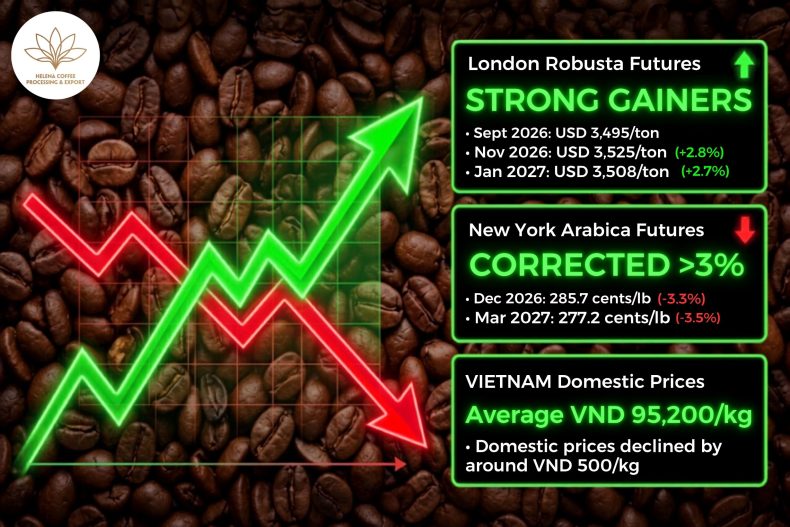
The market has since deflated in steps: $4,527/t for London November 2025 on 6 October 2025, $3,680/t for July 2026 on 18 June 2026, and about $3,470/t for November 2026 in mid-October, roughly 40% below the peak. Farm-gate robusta was VND 92,200–93,000/kg on 12 October 2026 (giacaphe.com, via our coffee prices report for 12 October 2026), and New York arabica for December was near 287¢/lb.
A Reuters poll of 11 analysts (25 March 2026) put the median end-2026 forecast at $2,500/t for robusta and 225¢/lb for arabica, with an 8.7-million-bag global surplus in 2026/27. With about 11 weeks of 2026 left, robusta is still almost $1,000/t above that median, so treat forecasts as scenarios, not plans. For the mechanics, see what drives the Vietnam robusta coffee price; for daily quotes, visit our coffee price today page.
Brazil’s bigger crop and the global balance
USDA’s July 2026 Coffee: World Markets and Trade forecasts record world production of 189.7 million bags in 2026/27 (+10.8 million), record consumption of 179.7 million and ending stocks of 26.3 million bags, still below the long-term average. Brazil is the swing factor: USDA expects a record 71.9 million bags, while Conab estimated 67.6 million (+19.6%) in September, as covered in our Brazil record coffee production report.
For robusta buyers, the key detail is that the increase is arabica. USDA sees world arabica up about 11.4 million bags to 105.9 million, but robusta down about 0.6 million to 83.8 million, as Brazil’s robusta slips to 24.4 million bags and Indonesia’s falls 1.0 million to 10.0 million. That helps explain why robusta has held up better than many forecasts expected.
Planning your 2027 coverage? Tell us your grades, volumes and shipment window. Our export team replies within 24 hours with the latest FOB Ho Chi Minh City price and offers free cupping samples to qualified buyers. Request a Quote
Where Value and Demand Are Moving
Processed coffee
Processed coffee is the quiet growth story of the Vietnam coffee industry 2026. Mainly instant plus roasted, it earned $1.2 billion in January–August (+1.7%) and reached 19.9% of coffee export revenue (MAE), a larger share because green-bean revenue fell. Our post on Vietnamese robusta moving to high-value products covers the factory investments behind it. Buyers gain more instant coffee and private-label options, while soluble plants compete with green exporters for the same robusta.
Fine Robusta
Selective picking, honey and natural processing and controlled fermentation are producing robusta that cups far above commercial grades. Our fine robusta anaerobic Vietnam lot scored 84.5 points under the CQI protocol, and Vietnamese lots featured strongly at the 2026 GCEF Global Robusta Awards (see Vietnamese robusta: from volume to Fine Robusta). It is still a premium niche, but it is changing how roasters view robusta.
Markets: Europe leads, Asia grows
Germany (13%), Italy (8.2%) and Japan (7.2%) were the top destinations in January–September 2026 (MAE). USDA names India, Cambodia, Thailand and China among the growing Asian markets and forecasts EU imports at 50.0 million bags in 2026/27, up from 46.5 million. See our analysis of Europe’s coffee market share for 2026–2031.
EUDR From 30 December 2026: What Changes for Buyers
For the Vietnam coffee industry, 2026 ends with its biggest regulatory change in years. As of October 2026, the EU Deforestation Regulation (EUDR) applies from 30 December 2026 to large and medium operators and from 30 June 2027 to micro and small operators, under amending Regulation (EU) 2025/2650 (European Commission Access2Markets). The Commission’s 4 May 2026 simplification package confirmed no further postponement and included a draft proposal to add soluble (instant) coffee to the scope.
Vietnam is rated “low risk” in the EU’s May 2025 benchmarking. That means simplified due diligence, not exemption: plot geolocation is still required, with evidence that the coffee is deforestation-free and legally produced.
- Ask suppliers how plot geolocation is collected, checked and handed over.
- Write EUDR data delivery into contracts, with a deadline before shipment.
- Fully documented lots may command firmer differentials if the market splits into two tiers.
- Instant coffee buyers should track the scope proposal and confirm obligations with their customs broker or legal adviser.
El Niño and Climate Risk for the 2026/27 Season
NOAA’s Climate Prediction Center has an El Niño Advisory in place. Its 8 October 2026 update put the Niño-3.4 anomaly at +2.1°C and said a strong-to-very strong El Niño is likely through January–March 2027, with a greater than 83% chance (NOAA ENSO diagnostic discussion). Vietnam’s National Center for Hydro-Meteorological Forecasting (via VietNamNet, 24 September 2026) expects rainfall 20–40% below normal through end-2026 in the south-central coast, Central Highlands and southern Vietnam, and rates drought risk in the early-2027 dry season as “very high”.
- 2026/27 crop (now being picked): drier weather can help sun-drying, but an early end to the rains may limit bean size in late areas. Check screen results on early lots.
- 2027/28 crop: the bigger risk. Robusta flowers in the January–April dry season and relies on irrigation, so water shortages could hurt fruit set.
- Brazil: StoneX (February 2026) flagged Brazil’s spring flowering and conilon as exposed to El Niño heat.
Our post on Vietnam coffee in the era of climate change explains drought’s effect on farm yields and margins.
Vietnam Coffee Industry 2026 Outlook: What Should Buyers Do?
Expect a better-supplied but still volatile market into 2027. Bigger Vietnamese and Brazilian crops argue for prices below 2025 levels, while flat world robusta output, EUDR friction and El Niño could keep robusta firmer than the bearish consensus. With risks running both ways, structure purchases instead of trying to call the bottom.
- Layer forward cover. Buy 2027 needs in tranches. Harvest selling often adds supply from November to March, but El Niño headlines can spark sharp rallies.
- Separate differential and futures decisions. Price-to-be-fixed (PTBF) contracts let you agree grade, shipment and differential now and fix the London price later, within an agreed window.
- Diversify grades and forms. Qualify more than one specification, such as screen 16 and screen 18 or natural and wet polished.
- Secure EUDR data before fixing price. From 30 December 2026, large and medium EU operators cannot place coffee on the market without completed due diligence, which needs plot geolocation.
- Tighten quality checks. Approve pre-shipment samples (PSS) and write moisture (12.5% max) and defect limits into contracts.
This is market commentary, not financial advice.
Frequently Asked Questions
What is the Vietnam coffee industry 2026/27 outlook?
USDA forecasts a record 32.5 million bags and exports near 28.95 million bags in 2026/27. Volumes are strong but prices are lower: the average export price was $4,537/t in January–September 2026, nearly 20% down year on year. Brazil’s crop, El Niño and EUDR from 30 December 2026 are the main swing factors to watch.
Will robusta prices keep falling in 2027?
Not necessarily. A March 2026 Reuters poll expected about $2,500/t by end-2026, yet London traded near $3,470/t in mid-October. Bigger Brazilian and Vietnamese crops point lower, but flat world robusta output, a strong El Niño and EUDR friction could support prices. Treat forecasts as scenarios and buy in tranches.
Does EUDR apply to Vietnamese coffee from December 2026?
Yes, as of October 2026. Large and medium EU operators must comply from 30 December 2026, and micro and small operators from 30 June 2027. Vietnam’s “low risk” rating means simplified due diligence, but production-plot geolocation is still required. Confirm your obligations with your customs broker or legal adviser.
When does Vietnam’s coffee harvest start?
Picking in the Central Highlands typically starts in October, with commercial volumes from November and most of the crop harvested by January, depending on area and weather. Beans are then dried, cleaned and graded, so new-crop availability builds through late 2026 and early 2027. Helena offers green coffee shipments every month.
Next Steps
The Vietnam coffee industry 2026 picture rewards buyers who plan: supply is ample, prices are well off their highs, and there is still time to structure 2027 coverage. At our Dak Lak mill (100 tons per day, with optical color sorting) we prepare export lots in 60 kg jute or PP bags, 19.2 MT per 20 ft container, shipped FOB Ho Chi Minh City (Cat Lai).
Browse our robusta green coffee beans, start with grade 1 robusta coffee beans new crop, or compare species in robusta vs arabica for roasters.
Ready to plan your 2027 coffee coverage? Send us your grades, volumes and destination port, and we will reply within 24 hours with FOB or CIF pricing and free cupping samples for qualified buyers. Request a Quote or WhatsApp +84 789 818 828.