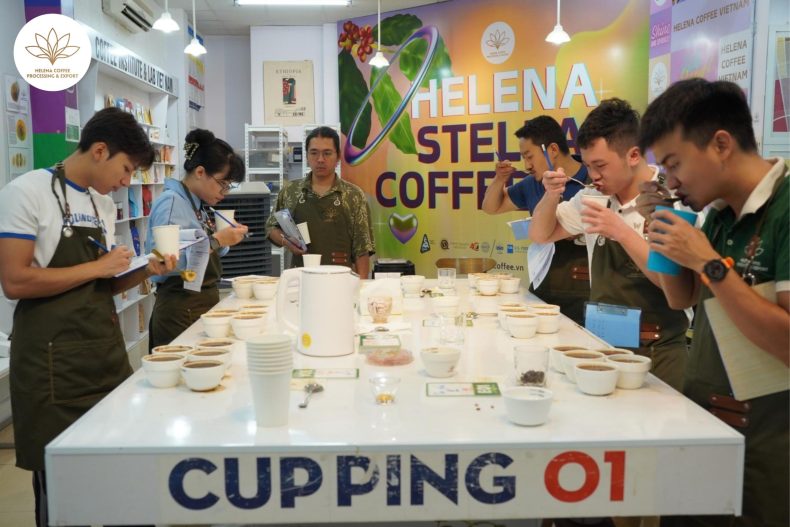
The certificate is not the point.
This is something most Q-Grader alumni only fully understand six months after the course. The certificate is the entry token; the calibrated palate it certifies is the actual asset. And what alumni do with that asset varies wildly depending on the role they walked into the course with.
This article tracks what changes practically, financially, structurally for the four most common roles after Q-Grader certification.
For the Coffee Buyer
Before Q-Grader:
You receive 30+ supplier samples per quarter. You cup them. You write notes. You make decisions, often in meetings where stakeholders question your reasoning. You have a “feel” for whether a coffee is worth the asking price, but defending that feel is hard.
After Q-Grader:
Your sample evaluation now produces structured data. Every sample is graded on four CVA forms Physical, Descriptive, Affective, Extrinsic that your team can audit, compare, and reference six months later when the contracted lot arrives. Your “feel” becomes a defensible spec sheet.
The biggest practical change: you can negotiate with origin in their language. When a producer’s lab scores a lot at 86 and yours at 84, you can specify exactly which descriptors and which intensity levels are driving the discrepancy. Producers respect this. Negotiations move faster, and lots that need adjustment get adjusted instead of rejected.

Financial impact: Buyers report 1–3% reduction in supplier disputes and rejections in the first year post-certification which on million-dollar inventory translates to meaningful margin recovery.
For the QC Manager / Roaster
Before Q-Grader:
Your team runs QC on roast batches. You catch obvious problems. The harder calls slight scorching, edge-case underdevelopment, subtle defect go to you, and you make a call based on experience.
After Q-Grader:
Your QC process now has a documented sensory standard tied to international methodology. Decisions become traceable. New hires can be calibrated against your standard rather than each developing their own.
The shift few people anticipate: you start catching problems earlier in the production chain. A Q-Grader-trained roaster identifies green coffee issues that previously only became visible in the cup and communicates them upstream to procurement. Quality decisions move from “fix in the cup” to “prevent before purchase.”
Operational impact: Most QC teams report a noticeable reduction in production batch variability within 90 days of having one Q-Grader on staff.
For the Producer / Exporter
This is the role with the most under-appreciated upside.
Before Q-Grader:
You produce coffee, send samples to buyers, receive scores back. You don’t always agree with the scores, but defending your position is hard you don’t have the same calibration the buyer has.
After Q-Grader:
You can pre-cup your own lots at the same standard your buyer uses. You can build your own internal scoring database to track how lot characteristics correlate with cup score over seasons. You can identify processing variables that consistently push your scores higher.
The structural change: you stop being a price-taker. When you can credibly score and defend your own coffee, you walk into negotiations from a position of evidence, not request.
For Vietnamese producers especially operating in a market that has historically been undervalued at the global level this matters. The producers building premium brands in Da Lat, Son La, and Lam Dong are increasingly Q-Grader certified. It’s not coincidence.
Financial impact: Anecdotal but consistent producers report being able to defend per-kg premiums of $0.30–$1.20 USD on their certified-quality lots after gaining Q-Grader certification.
For the Career-Changer
The fourth pattern: people who enter the course not yet established in coffee.
Before Q-Grader:
You’re transitioning from another industry into coffee. You may have barista experience or business background, but you don’t have a credential that signals seriousness to potential employers or clients.
After Q-Grader:
You have one of the most respected credentials in the industry. CVs that include “Q-Grader (CQI/SCA)” move differently in hiring pipelines for buyer roles, QC roles, and roastery leadership roles.
The shift here is more subtle but real: you gain access to conversations. Industry events, supplier meetings, certification audits Q-Grader is often the implicit ticket. Before certification, you’re explaining yourself. After, you’re contributing.
Career trajectory impact: A material portion of Helena’s career-changer alumni report job placements or promotions within 12 months of certification.
What doesn’t change
Worth saying clearly: Q-Grader is not magic.
It does not turn a poor coffee professional into a great one. It does not replace business acumen, relationship-building, or operational discipline. People who were going to drift in their careers will still drift, certificate or not.
What it does is remove a specific bottleneck: the inability to evaluate coffee quality at the same level as the people you negotiate with, sell to, or buy from. That bottleneck, once removed, lets the rest of your skills compound.
How to maximize the certification
Three patterns we observe across alumni who get the most from the credential:
1. Cup regularly post-course.
A calibrated palate decays in 6–12 months without practice. Alumni who cup at least 2–3x weekly retain calibration. Those who don’t, lose it and Q-Grader certificates require recalibration testing every 36 months to remain valid.
2. Build a small internal cupping community.
Solo cupping is fine for QC. Calibration is sharpened by group cupping, where descriptors and scores are compared. Alumni who form 3–4 person cupping groups in their company or city retain the most.
3. Apply CVA in actual decisions.
The credential adds value when it shows up in your work in spec sheets, contracts, supplier conversations, blend development. Alumni who keep it in the background for “personal interest” extract significantly less value than those who weave it into operations.
Final thought
The Q-Grader certificate is the smallest part of the Q-Grader course. The palate, the framework, the network of fellow alumni, and the new vocabulary you bring back to your role those are the assets.
If you’re considering certification, ask yourself a more useful question than “Should I take it?” Ask: “What specifically will I use this for in my work in the first 90 days after certification?” If you can answer that with two or three concrete commitments, the course is going to repay itself many times over.
📍 Next Q-Grader cohort at Helena Coffee, Buon Ma Thuot →/q-grader-course/
👉 Visit www.helenacoffee.vn or Info@helenacoffee.vn to explore our products and request a direct quote today!