Coffee prices on March 9 recorded a notable increase in robusta futures while domestic coffee prices in Vietnam continued to trade at high levels. Although the global coffee market appears relatively stable in the short term, several factors including weather conditions, geopolitical tensions, and global supply dynamics are continuing to influence the direction of coffee prices worldwide.
According to the latest market data, domestic coffee prices in Vietnam are currently fluctuating between 96,300 VND and 96,700 VND per kilogram, while international coffee prices on major exchanges have remained relatively stable after a series of strong gains.
Global Coffee Prices Today
On the international market, coffee prices on the two major trading exchanges London and New York remain steady.
Specifically:
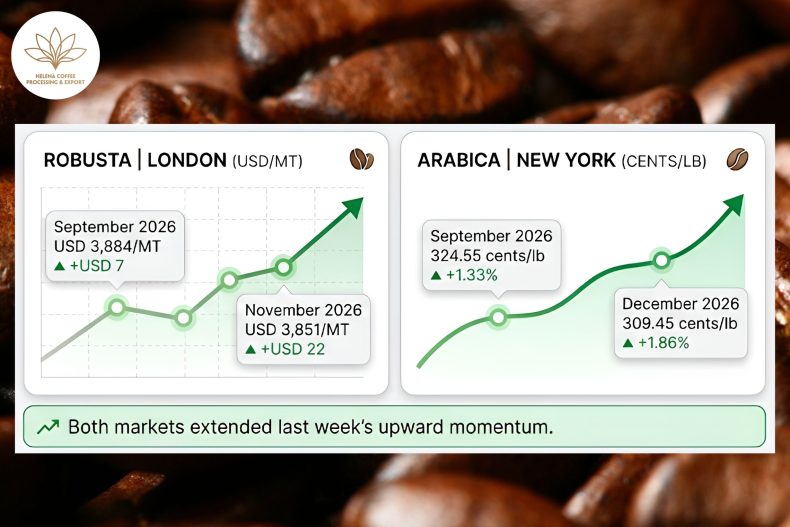
Robusta coffee futures for March 2026 on the London exchange are trading at $3,827 per metric ton
The May 2026 robusta contract stands at $3,772 per ton
Meanwhile, Arabica coffee futures on the New York exchange show:
March 2026 contract: 297.60 cents per pound
May 2026 contract: 293.30 cents per pound
Overall, global coffee prices have maintained a stable trend following several consecutive sessions of gains. Market data indicates that over the past week:
Arabica prices increased by approximately 4.5%
Robusta prices rose by nearly 4%
This upward movement reflects growing concerns about global coffee supply as weather conditions and geopolitical developments continue to affect logistics and production.

Domestic Coffee Prices in Vietnam
In Vietnam, coffee prices today remain unchanged compared with the previous day but continue to stay at historically high levels in many coffee-growing regions.
Lam Dong Province
In Lam Dong Province, coffee prices are currently being purchased at around 96,300 VND per kilogram across several key coffee-growing districts, including Di Linh, Bao Loc, and Lam Ha, where local traders continue to maintain stable buying levels.
Dak Lak Province
In Dak Lak Province, coffee prices are slightly higher compared to some other regions. Traders are currently purchasing coffee at around 96,500 VND/kg in Cu M’gar, while prices in Ea H’leo and Buon Ho are trading at approximately 96,400 VND/kg.
Dak Nong Province
Dak Nong currently records the highest domestic coffee prices, with traders purchasing coffee at around 96,700 VND/kg in Gia Nghia, while in Dak R’lap, prices are slightly lower at approximately 96,600 VND/kg.
Gia Lai Province
Kon Tum Province
Coffee prices in Kon Tum are currently trading at around 96,400 VND/kg.
Overall, Vietnam’s domestic coffee prices are moving sideways today, with a trading range between 96,300 and 96,700 VND/kg.
However, compared with last week, prices have increased by approximately 500–800 VND/kg, reflecting the recovery trend in global coffee prices and farmers’ reluctance to sell due to supply concerns.
Key Factors Influencing Coffee Prices
Dry Weather in Brazil
One of the most important drivers of coffee prices in the global market is weather conditions in Brazil the world’s largest coffee producer and exporter.
Many coffee-growing regions in Brazil are currently experiencing prolonged dry conditions, raising concerns about the upcoming harvest season.
Lack of rainfall during critical crop development stages may affect:
Coffee yield
Bean quality
Global supply levels
Although weather forecasts suggest rainfall could return soon, traders remain cautious about potential production risks.
Geopolitical Tensions in the Middle East
Another major factor supporting coffee prices is geopolitical instability in the Middle East.
Recent military strikes involving the United States, Israel, and Iran have intensified regional tensions. Iran has reportedly threatened to block the Strait of Hormuz, one of the world’s most critical maritime shipping routes.
Such disruptions could significantly affect global trade by increasing:
Shipping insurance costs
Freight rates
Delivery delays
In addition, the Houthi movement in Yemen may resume attacks on commercial vessels in the Red Sea, a vital shipping corridor for global trade.
If shipping companies avoid the Red Sea and Suez Canal routes, vessels may need to reroute around the Cape of Good Hope in South Africa, adding 7 to 14 days to shipping times and increasing transportation costs.
These disruptions could further support higher coffee prices due to increased logistics costs.

Declining Coffee Exports from Brazil and Colombia
Supply data from major producing countries is also influencing the global coffee market.
According to Brazil’s Foreign Trade Secretariat (SECEX):
Brazil exported 2.5 million bags (60 kg each) of coffee in February
This represents a 16.2% decrease compared with the same period last year
During the first two months of 2026:
Total exports reached 4.973 million bags
Down 31.5% year-on-year
Meanwhile, Colombia another major arabica producer reported significant production declines.
Data from the Colombian Coffee Growers Federation shows:
February production reached 869,000 bags
Down 36% compared with last year
Lower production from these major suppliers has contributed to rising coffee prices in global markets.
Vietnam’s Coffee Exports Increase
In contrast, Vietnam the world’s largest robusta producer has reported rising export volumes.
During the first two months of 2026:
Coffee exports reached 366,000 tons
An increase of 14% compared with the same period last year
In February alone:
Vietnam exported approximately 141,000 tons of coffee
Generating about $672 million in export revenue
However, total export value for the first two months reached $1.76 billion, slightly down 1.3% year-on-year.
This indicates that while export volume has increased, fluctuations in coffee prices continue to influence overall trade value.
ICE Coffee Inventory Shows Signs of Recovery
Despite rising prices, the market’s upward momentum is being partially limited by increasing inventories monitored by the Intercontinental Exchange (ICE).
As of March 6:
Arabica inventories reached 540,867 bags, the highest level in five months
Robusta inventories increased to 4,721 lots, the highest level in more than three months
Rising inventories may help ease supply concerns and limit further increases in coffee prices in the short term.
Outlook for Coffee Prices
Overall, coffee prices are currently influenced by a combination of factors, including:

Weather conditions in Brazil
Geopolitical tensions in the Middle East
Export declines from major producers
Inventory levels on global exchanges
In the near term, the market may continue to move sideways. However, if supply concerns intensify or logistics disruptions worsen, global coffee prices could rise again.
For Vietnam, domestic coffee prices remain significantly higher than historical averages, offering opportunities for farmers and exporters. However, businesses must closely monitor market developments to manage risks effectively.
In an increasingly complex global market, coffee prices will remain a key indicator reflecting the balance between supply, demand, and geopolitical influences shaping the global coffee industry.
Helena Coffee Vietnam: A Reliable Partner in the Coffee Market
Helena Coffee Vietnam supports global buyers with stable supply and consistent quality coffee from Vietnam’s key growing regions. With reliable sourcing and flexible export solutions, Helena helps partners navigate the fluctuating coffee market while maintaining long-term supply stability.
👉 Visit www.helenacoffee.vn or Info@helenacoffee.vn to explore our products and request a direct quote today!