Coffee prices continued their upward momentum on international exchanges, supported by strong Arabica buying interest, limited Brazilian exports, and cautious selling from producers. While Brazil’s coffee harvest is progressing steadily, market participants remain focused on supply availability, export bottlenecks, and speculative fund positioning.
As the world’s largest coffee producer enters a new marketing season, traders are watching whether tighter supplies and improved farmer bargaining power will continue supporting coffee prices in the weeks ahead.
Global Coffee Prices Today
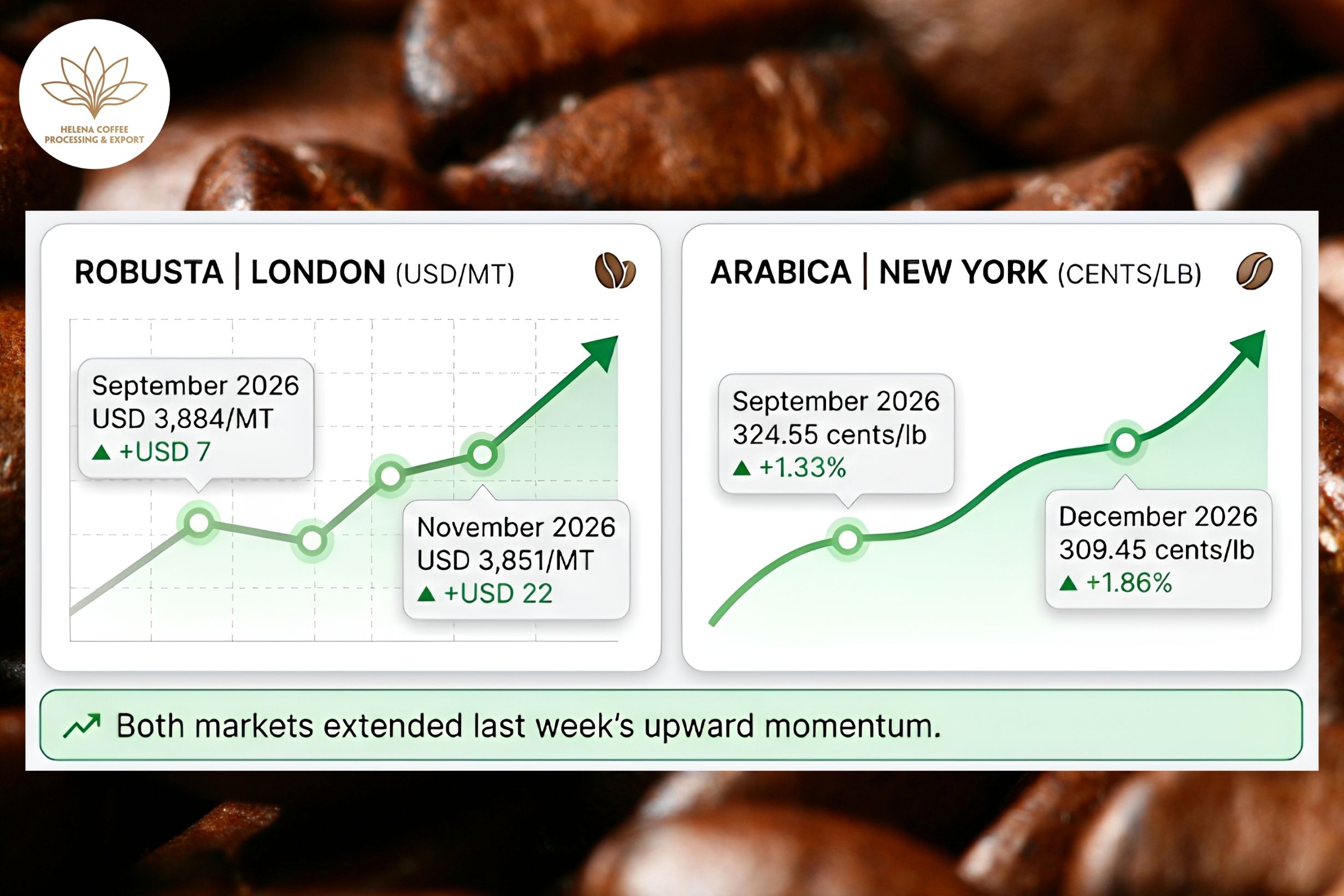
The latest trading session on July 20 ended with gains in both Robusta and Arabica futures.
London Robusta Futures
- September 2026: US$3,884/MT, up US$7 (+0.18%)
- November 2026: US$3,851/MT, up US$22 (+0.57%)
New York Arabica Futures
- September 2026: 324.55 cents/lb, up 4.25 cents (+1.33%)
- December 2026: 309.45 cents/lb, up 5.65 cents (+1.86%)
The gains reflect continued confidence among traders despite ongoing uncertainty surrounding Brazil’s supply outlook.

Brazil’s Harvest Progress Remains Stable
Brazilian brokerage Carvalhaes noted that recent market volatility has complicated trading activity.
According to the brokerage:
Sellers are waiting for clearer price direction and are currently selling only enough coffee to cover short-term operating expenses. This cautious selling behavior has reduced immediate supply available to exporters, providing additional support to coffee prices despite the ongoing harvest.
Speculative Funds Increase Activity in the Coffee Market
Market sentiment has also been influenced by investment funds.
Specifically:
- Net short positions on ICE US Arabica futures increased by 2,231 contracts
- Total net short positions reached 12,454 contracts
Large speculative positions often increase market volatility, making coffee prices more sensitive to new production or weather-related information.
Brazil’s 2025–2026 Coffee Exports Fell Sharply
Brazil officially closed its 2025–2026 coffee marketing year (July 2025 – June 2026) with significantly lower exports.
According to the Brazilian Coffee Exporters Council (Cecafé):
- Total exports reached 38.46 million bags
- Down 15.7% compared to the previous season
- Lowest export volume since the 2022–2023 crop year
Despite lower shipment volumes, export earnings remained relatively resilient.
Export Revenue
- Nearly US$14.6 billion
- Only about 1% lower than the previous year
The reason lies in significantly higher coffee prices. The average export price increased by 17.4%, reaching:
- US$379.48 per bag
Higher export values helped offset the decline in shipment volumes.
Green Coffee Exports Declined Across Both Arabica and Robusta
The decline was visible across nearly every coffee category.
Green Coffee Exports
- 34.53 million bags (Down 16.6%)
Arabica
- 29.5 million bags (Down 15.3%)
Robusta
- 5.03 million bags (Down 23.5%)
Processed coffee exports also declined but remained an important contributor.
Processed Coffee
- 3.93 million bags (Down 6.7%)
- Instant coffee represented the majority of these exports.
Why Did Brazil’s Coffee Exports Drop?
According to Cecafé President Márcio Ferreira, several factors contributed to weaker exports.
Limited Coffee Supply
Brazil entered the new season with much smaller inventories after recording record exports during 2024. At the same time, unfavorable weather conditions reduced production during the 2025 harvest. Lower inventories naturally restricted export availability.
Port Congestion Increased Export Costs
Brazil’s aging port infrastructure has become another significant obstacle.
Major ports experienced:
- Overcrowded storage yards
- Delayed vessel departures
- Hundreds of thousands of coffee bags waiting for shipment
Exporters have consequently faced millions of dollars in additional expenses related to:
- Warehousing
- Container storage
- Port handling fees
These logistical issues continue slowing coffee exports despite healthy international demand.
U.S. Tariffs Reduced Shipments
Ferreira also explained that the 50% tariff imposed on Brazilian coffee for approximately four months significantly affected exports to the United States.
During this period:
- Coffee shipments to the U.S. fell by more than 50%
This contributed substantially to the weaker export performance recorded throughout the entire marketing year.

Strong Farmer Finances Are Changing Selling Behavior
Another factor supporting coffee prices is the financial position of Brazilian growers. After several years of historically high coffee prices, many producers are under less financial pressure to sell immediately after harvest.
Ferreira explained that limited inventories between harvest seasons have given farmers greater flexibility.
For:
- Canephora (Conilon and Robusta): farmers could delay sales until May
- Arabica: farmers maintained flexibility until July
Instead of selling aggressively, producers are choosing the most favorable market opportunities.
This strategy limits available supply in the short term and supports higher international prices.
Coffee Quality Remains a Key Market Focus
Although harvest progress continues, buyers are closely monitoring the quality of Brazil’s Arabica crop. Recent rainfall during harvesting has raised concerns over bean quality in certain producing regions.
Final production figures and quality assessments will likely influence export performance throughout Brazil’s new crop year, which officially began in July. For importers and roasters, quality is becoming just as important as production volume.
What Do Rising Coffee Prices Mean for the Global Market?
The latest market developments highlight that coffee prices are currently being supported by several interconnected factors:
- Stable but slower Brazilian harvesting
- Farmers delaying sales
- Lower export volumes
- Reduced inventories
- Port logistics challenges
- Strong speculative activity in futures markets
- Ongoing uncertainty surrounding crop quality
Although production continues, the market remains cautious because available export supplies have not expanded as quickly as many expected.
As long as Brazilian farmers continue managing sales strategically and logistical challenges persist, coffee prices may remain well supported throughout the coming months.
Helena Coffee Vietnam – Your Trusted Coffee Export Partner
As one of Vietnam’s leading coffee manufacturers and exporters, Helena Coffee Vietnam supplies premium Robusta, Arabica, specialty coffee, roasted coffee, and instant coffee to partners worldwide.
With direct sourcing from Vietnam’s top coffee-growing regions, strict quality control, OEM/private label services, and flexible export solutions, Helena helps importers, distributors, and coffee brands build reliable long-term supply chains.
Whether you’re looking for green coffee beans, roasted coffee, or customized private label products, Helena Coffee Vietnam is ready to support your business with consistent quality and competitive global pricing.
👉 Visit www.helenacoffee.vn or Info@helenacoffee.vn to explore our products and request a direct quote today!