Coffee prices today, August 10, 2026, are moving in opposite directions across the two major international exchanges. While Robusta coffee prices in London edged lower, Arabica coffee prices in New York recorded a sharp increase of more than 4%.
The contrasting movements highlight how global coffee prices are being influenced by different supply conditions, crop expectations, inventories, and consumption trends. At the same time, coffee prices in Vietnam remain relatively high despite a slight domestic correction.
Robusta Coffee Prices Edge Lower
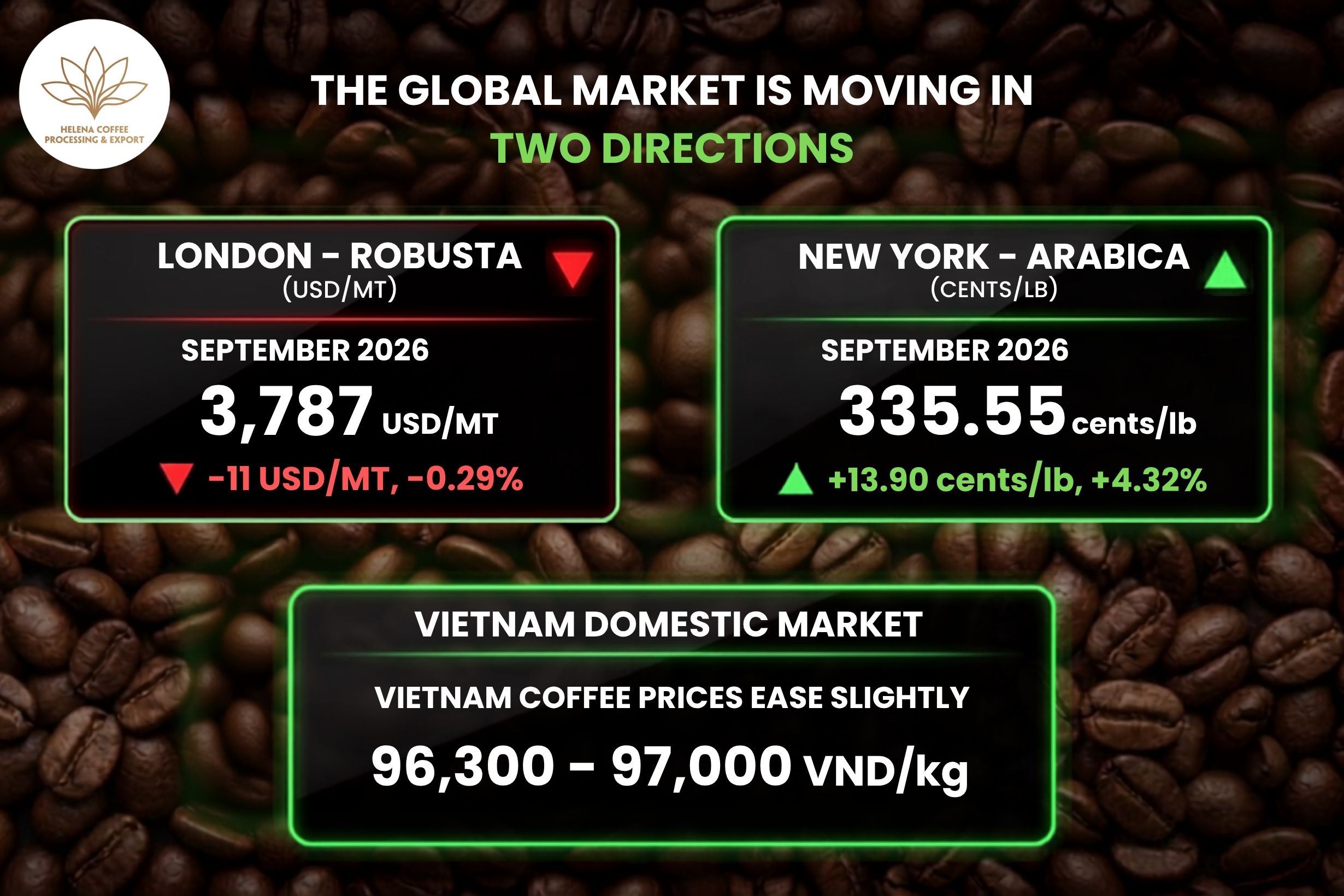
As of the morning of August 10, Vietnam time, London Robusta futures for September 2026 fell 0.29%, equivalent to USD 11 per ton, to USD 3,787 per ton. During the latest trading session, London Robusta prices fluctuated between approximately USD 3,682 and USD 3,850 per ton.
Although the decline was relatively limited, the movement reflects continued volatility in the global coffee market. Traders remain focused on supply developments from major producing countries, particularly Vietnam and Brazil.

Arabica Coffee Prices Rise Sharply
Unlike Robusta, New York Arabica coffee prices recorded a strong increase. The September 2026 Arabica contract reached 335.55 US cents per pound, up 4.32%, or 13.90 US cents per pound, from the previous session.
The sharp increase demonstrates how sensitive the Arabica market remains to concerns surrounding global supply, particularly production and harvesting conditions in Brazil.
Brazil is the world’s largest coffee-producing country and one of the most important sources of Arabica coffee. Therefore, any disruption to harvesting, drying, or crop development can quickly influence international coffee prices.
Vietnam Coffee Prices Decline Slightly
While international coffee prices were mixed, domestic coffee prices in Vietnam recorded a slight decline.
According to data updated on August 9, coffee prices across Vietnam’s Central Highlands ranged between approximately VND 96,300 and VND 97,000 per kilogram.
The regional prices were approximately:
- Dak Nong: VND 97,000/kg, down VND 500/kg.
- Dak Lak: VND 96,800/kg, down VND 500/kg.
- Gia Lai: VND 96,800/kg, down VND 500/kg.
- Lam Dong: VND 96,300/kg, down VND 500/kg.
Despite this correction, domestic coffee prices remain at relatively high levels. Limited available inventories and farmer selling strategies continue to play an important role in determining the physical market.
When prices remain attractive, farmers and traders may choose to hold part of their inventories instead of selling immediately. This can reduce short-term availability and create additional sensitivity in the domestic market.
Why Are Robusta and Arabica Moving Differently?
The different movements between Robusta and Arabica reflect the distinct supply and demand dynamics affecting each market.
Arabica prices are currently receiving stronger support from concerns about Brazil’s crop outlook. Meanwhile, Robusta prices are more closely linked to expectations surrounding Vietnam’s next crop and global demand for lower-cost coffee.
Brazil and Vietnam play different but equally important roles in the global coffee supply chain. Brazil dominates Arabica production, while Vietnam remains the world’s leading producer and exporter of Robusta.
As a result, changes in weather, production, harvesting progress, inventories, and farmer selling can affect each market differently.
Southeast Asia Coffee Consumption Continues to Grow
The coffee market story is not only about commodity prices. Consumption is also becoming an increasingly important driver of the industry.
Indonesia remained the largest market at around USD 3.51 billion, followed by Thailand at USD 2.25 billion.
Vietnam ranked third, with a market value of approximately USD 1.34 billion, followed by Malaysia at USD 1.02 billion, the Philippines at USD 0.95 billion, and Singapore at USD 0.81 billion.
The development of modern coffee chains is particularly important for Vietnam because the country combines a strong coffee-producing base with a long-established coffee-drinking culture.
Vietnam’s Coffee Market Has Strong Growth Potential
Vietnam’s position in Southeast Asia is supported not only by its production capacity but also by growing domestic consumption.
The modern coffee-chain market in Vietnam reached approximately USD 725 million in 2025, representing a 27% increase from approximately USD 572 million in 2024.
This growth suggests that Vietnam’s coffee industry is increasingly developing beyond traditional commodity exports.
Specialty coffee shops, modern chains, ready-to-drink products, roasted coffee, instant coffee, and private-label products are creating new opportunities throughout the value chain.
For exporters and coffee manufacturers, this means that market opportunities increasingly extend beyond simply selling green beans.
Global Supply Drives Coffee Prices
Although coffee prices today are moving in different directions, global supply remains one of the most important factors influencing the market. When production forecasts increase, prices may come under pressure. Conversely, unexpected weather problems, delayed harvesting, or lower-than-expected production can quickly push prices higher.
Inventories are another important indicator. When exchange-certified stocks decline, the market becomes more sensitive to any negative supply news. Traders may react more aggressively because there is less readily available coffee to absorb short-term disruptions.
Importers, exporters, roasters, and traders should also monitor:
- Global coffee inventories
- Crop development
- Weather forecasts
- Harvesting progress
- Currency movements
- Futures market positioning
- Consumer demand
- Export volumes from major origins
Coffee Prices May Remain Volatile
The August 10 market provides another example of the uncertainty currently affecting global coffee prices. London Robusta declined 0.29% to USD 3,787/ton, while New York Arabica jumped 4.32% to 335.55 US cents/lb.
This divergence does not necessarily indicate that one market is entering a long-term bearish trend while the other is becoming permanently bullish. Instead, it reflects different expectations regarding supply, demand, and crop conditions. These factors could determine whether coffee prices continue rising, stabilize, or experience another correction.

Vietnam Remains a Strategic Coffee Origin
Despite short-term price fluctuations, Vietnam continues to hold a strategically important position in the global coffee industry.
The country’s strength in Robusta production, combined with growing domestic consumption and the expansion of modern coffee businesses, provides opportunities across multiple segments of the supply chain.
For exporters, the challenge is no longer simply securing coffee at a competitive price. Buyers increasingly expect consistency, traceability, quality control, reliable logistics, and flexible product specifications.
This creates opportunities for Vietnamese suppliers that can move beyond commodity trading and provide higher-value solutions such as specialty coffee, roasted coffee, instant coffee, OEM production, and private-label services.
Final Outlook
Coffee prices today reflect a divided market, with Robusta correcting while Arabica rises sharply. Vietnam’s domestic prices remain near VND 100,000/kg, supported by tight supply and strong demand. As Southeast Asia’s coffee market continues to grow, businesses need to look beyond daily prices and monitor supply, inventories, weather, crop forecasts, and demand. In a volatile market, understanding why coffee prices move can be more valuable than simply predicting where they will go next.
Helena Coffee Vietnam — Connecting Vietnam’s coffee origins with global markets.
At Helena Coffee Vietnam, we supply quality Vietnamese Robusta, Arabica, and Specialty Coffee to importers, roasters, and brands worldwide. From green and roasted coffee to OEM and private label solutions, we provide reliable sourcing and export support tailored to your market.
👉 Visit www.helenacoffee.vn or Info@helenacoffee.vn to explore our products and request a direct quote today!