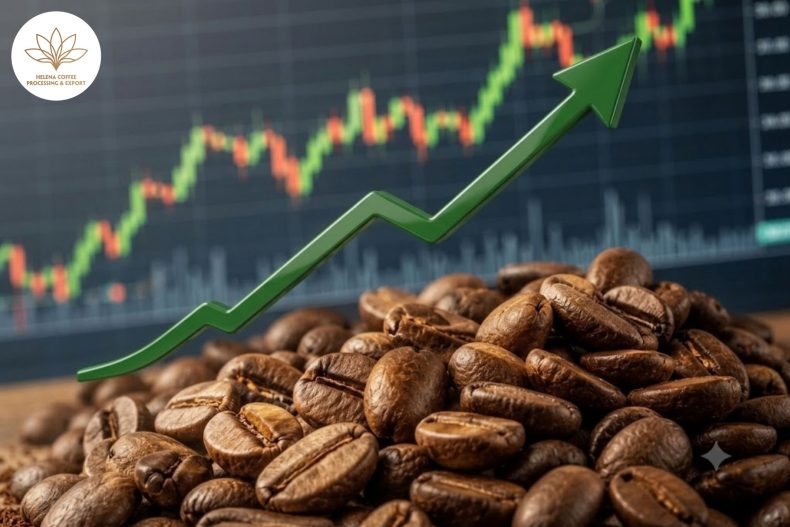
The global coffee price retreated sharply in early February after a strong rally, as traders reassessed short-term tightness against a more optimistic supply outlook for the second half of the year. Markets are now entering a corrective phase, where expectations around Brazil’s upcoming harvest are beginning to outweigh near-term supply constraints.
While structural risks remain, the latest move highlights how sensitive the coffee price has become to forward-looking signals rather than confirmed production data.
Global Coffee Price Update
On the London market, robusta coffee prices softened modestly over the past week. The March 2026 contract declined by 0.7% (USD 29/ton), settling at USD 4,113/ton, while the May 2026 contract slipped 0.3% (USD 14/ton) to USD 4,037/ton.
The correction was more pronounced in New York. Arabica coffee prices for March 2026 dropped sharply by 5.3% (17.8 US cents/lb) to 332.25 US cents/lb. The May 2026 contract fell 5.4% (18.1 US cents/lb), closing at 315.35 US cents/lb.
According to Bloomberg, the pullback reflects a shift in market focus: traders are increasingly weighing the prospect of improved supply later in the year rather than concentrating solely on immediate tightness.

Brazil’s Crop Outlook Weighs on Coffee Prices
Brazil remains the single most influential factor in global coffee price formation. As the world’s largest producer, any change in expectations for Brazil’s output has an outsized impact on futures markets.
Despite slower selling activity from Brazilian producers compared with last year, consensus expectations point toward a larger 2026–2027 crop. Independent forecasts currently place Brazil’s next harvest at around 71 million bags, with picking expected to begin in May.
Recent weather reports have reinforced this outlook. Rainfall across key coffee-growing regions has been broadly favorable, and temperatures in Brazil’s coffee belt are ranging between 25°C and nearly 30°C. These conditions support healthy crop development and have eased fears of significant yield losses a key reason why the coffee price has come under pressure.
Markets tend to price in anticipated supply well before harvest results are known, which explains why coffee prices are adjusting now rather than later in the year.
Currency Movements and Producer Behavior
Currency dynamics have also played a role in recent coffee price movements. The U.S. dollar has weakened noticeably against the Brazilian real in recent weeks, reducing export incentives for Brazilian producers. A stronger real means farmers receive fewer local-currency returns when selling coffee internationally, prompting some to delay sales.
However, while this factor has limited selling pressure at origin, it has not been sufficient to counteract broader bearish sentiment tied to the improved crop outlook. As a result, the coffee price continues to reflect expectations of increased availability later in the year.

Speculative Activity and Market Corrections
Market participants widely agree that the previous rally in coffee prices was driven in part by speculative positioning. Harry Howard, a soft commodities broker at Sucden Financial, noted that recent gains appeared more speculative than fundamentally justified.
From this perspective, the current decline represents a technical correction rather than a fundamental reversal. After strong upward moves, futures markets often retrace as traders lock in profits and reposition ahead of new data.
This behavior underscores a critical feature of the coffee market: prices are not solely determined by physical supply and demand, but also by expectations, sentiment, and financial flows.
Demand-Side Signals: Starbucks and the U.S. Market
On the demand side, large buyers are also adapting to elevated coffee prices. Starbucks recently reported better-than-expected earnings and a positive outlook, while acknowledging that high coffee prices and rising labor costs have pressured margins.
According to CFO Cathy Smith, Starbucks expects coffee and tariff-related costs to peak in the second quarter of 2026 before easing in the second half of the year. This guidance aligns with market expectations that coffee prices may moderate if supply conditions improve.
In the United States, the National Coffee Association (NCA) released its 2026 Coffee Industry Outlook, forecasting only modest growth for the U.S. coffee sector. Growth is expected to be driven more by value than volume, as consumers remain price-conscious amid persistent economic uncertainty.
U.S. coffee industry sales reached approximately USD 20 billion in 2025, up 1.52% year-on-year, with only slight expansion projected for 2026. Notably, around 70% of coffee consumed in the U.S. is prepared at home, reflecting a shift toward cost-saving consumption habits as coffee prices remain elevated.
Vietnam Market Activity Slows During Lunar New Year
In Vietnam, domestic trading activity is expected to slow in the second half of February due to the Lunar New Year holiday, which begins on February 17, 2026. During this period, farmers and exporters typically pause transactions for about a week.
While this seasonal slowdown may cause short-term fluctuations in local prices, it is unlikely to have a lasting impact on global coffee price trends.
Coffee Price Outlook: What Comes Next?

Looking ahead, the near-term direction of the coffee price will largely depend on confirmation of Brazil’s crop prospects. If weather conditions remain favorable and production meets expectations, further price corrections are possible.
However, this does not eliminate longer-term risks. Global coffee inventories remain relatively low, climate volatility continues to pose structural challenges, and demand growth particularly in Asia remains intact. These factors suggest that while prices may ease, volatility is likely to persist.
Rather than returning to a stable, low-price environment, the coffee market appears set to operate within a higher and more volatile range.
Conclusion
The decline in coffee price today (Feb 2) reflects a market recalibrating after a speculative-driven rally and turning its attention to Brazil’s upcoming harvest. Short-term pressure is coming from improved supply expectations, but the broader landscape remains complex.
For producers, traders, and buyers, monitoring coffee prices requires more than tracking daily quotes. Understanding crop development, currency movements, speculative behavior, and consumption trends is essential to navigating a coffee market where volatility has become the norm rather than the exception.
Helena Coffee: A Reliable Partner in a Volatile Coffee Market
At Helena Coffee Vietnam, we work directly at origin to help partners stay ahead of coffee price volatility. With transparent sourcing from Vietnam, flexible contracts, and consistent quality, Helena supports roasters and importers in managing risk and securing reliable supply — even when the global coffee market is under pressure.
👉 Visit www.helenacoffee.vn or Info@helenacoffee.vn to explore our products and request a direct quote today!