In today’s coffee industry especially in the specialty segment coffee harvesting is no longer simply about picking red cherries. Behind every harvest lies a complex scientific system where bean quality is determined by far more than external color. Understanding coffee harvesting correctly is the first step toward producing a truly high-quality cup.
Main Contents
ToggleCoffee Harvesting: Why 100% Ripe Isn’t Always Better
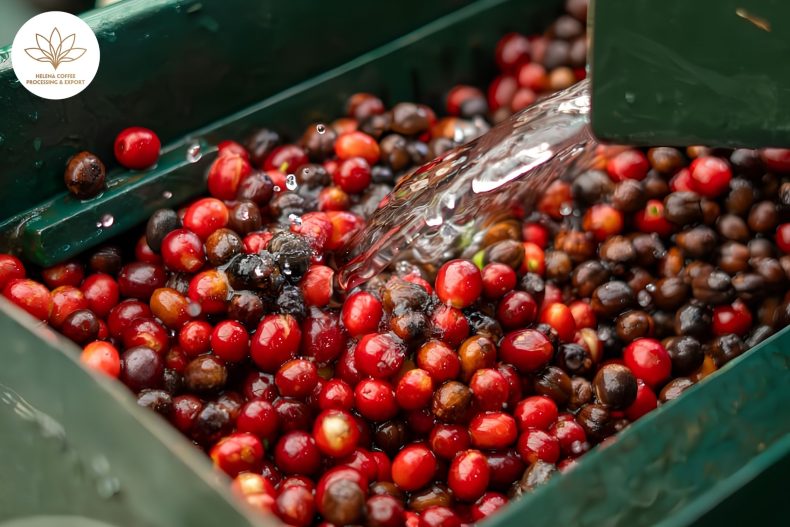
Bright red coffee cherries are often seen as the gold standard. However, chasing a 100% ripe rate in coffee harvesting does not always lead to the best results.
First, ripeness is not an absolute state but a spectrum. In practice, a high-quality lot typically contains about 90–95% ripe cherries. Trying to reach 100% may result in including overripe cherries that have already begun biochemical degradation.
Second, overripe cherries increase the risk of uncontrolled fermentation during transport. This can lead to off-flavors that are difficult to fix later.
Third, the labor cost required to achieve near-perfect ripeness can be significantly higher, while the improvement in cup quality is often marginal. Therefore, effective coffee harvesting requires balancing quality and economic efficiency rather than chasing perfection.

The Science Behind Coffee Ripening
To better understand coffee harvesting, we need to look at the internal biochemical changes rather than just the fruit’s color.
Color Transformation
As coffee cherries ripen, chlorophyll breaks down while pigments such as anthocyanins (red) or carotenoids (yellow) develop. However, color is only a visual indicator not a full measure of internal quality.
Sugar Accumulation
During ripening, starches and organic acids are converted into sugars like glucose and fructose, mainly in the mucilage. These sugars later serve as key substrates for fermentation.
Formation of Flavor Precursors
Compounds such as amino acids, chlorogenic acids, and sucrose in the bean form the foundation for Maillard reactions and caramelization during roasting critical for flavor development.
The Truth: Sugar Does Not “Move” into the Bean
A common belief in coffee harvesting is that leaving cherries longer on the tree allows sugars from the pulp to penetrate the bean, making it sweeter. Scientific research, however, proves otherwise.
The coffee bean (endosperm) and fruit pulp follow largely independent biochemical pathways. Sucrose, the primary sugar responsible for sweetness is accumulated early and reaches saturation when the cherry begins to ripen. It does not significantly increase as the fruit turns deep red.
This means:
- Sweetness does not come from “over-ripening” on the tree
- Bean quality is determined internally during development
- Mucilage sugars support fermentation but do not directly increase bean sweetness
The Key Factor in Coffee Harvesting: Uniformity
If ripeness alone isn’t everything, what truly matters in coffee harvesting?
The answer is uniformity.
A uniform lot of coffee cherries offers several advantages:
Consistency in Processing
In washed processing, evenly ripe cherries are easier to pulp without damaging the beans. Uniform sugar levels in the mucilage also allow for more controlled and predictable fermentation.
Better Roasting Performance
When beans are similar in size, density, and composition, heat transfers more evenly during roasting. This prevents issues such as:
- Scorching on the outside while underdeveloped inside
- Quakers (defective beans from underripe cherries)
Improved Cup Quality
Uniformity leads to a more balanced cup profile, with better clarity, sweetness, and overall harmony.
Best Practices for Coffee Harvesting
To optimize quality, producers should adopt data-driven approaches to coffee harvesting rather than relying solely on visual cues.
Use a Brix Meter
Measuring sugar content in the fruit provides a more accurate indicator of ripeness. A higher Brix level (often above 20%) is a reliable signal for harvesting.
Sort by Ripeness Level
Instead of eliminating all variation, producers can use it strategically:

- High-ripeness lots (~95%): ideal for Natural or Honey processing
- Medium-ripeness lots (~85%): suitable for Washed processing
Control Post-Harvest Processing
Even the best coffee harvesting practices must be supported by controlled fermentation, washing, and drying to ensure final quality.
Conclusion: Coffee Harvesting Is About Balance
Coffee harvesting is not about achieving 100% ripe cherries, it is about finding the optimal balance between:
- Physiological ripeness
- Raw material uniformity
- Production costs
- Processing control
A great cup of coffee does not begin at brewing it begins with the right decisions made on the tree. By understanding the science behind ripening and focusing on uniformity, coffee producers can consistently deliver higher quality and create long-term value across the supply chain.
Quality Coffee Starts at Origin with Helena Coffee
Helena Coffee stands at the heart of Vietnam’s coffee capital, delivering consistent, high-quality green and roasted beans sourced directly from origin. With a deep focus on uniformity, traceability, and flavor integrity, Helena Coffee Vietnam helps partners turn great harvesting practices into exceptional cups reliably and at scale.