Coffee prices rose sharply last week on both the London and New York exchanges as concerns about the developing El Niño weather pattern increased uncertainty over future coffee supplies. Robusta and Arabica futures gained momentum after traders covered short positions amid fears of droughts, flooding, and crop quality risks in major producing countries. Additional support came from reports of smaller bean sizes in Brazil’s new harvest, while Peru’s production outlook remained relatively stable. Going forward, coffee prices are expected to remain highly sensitive to weather developments, harvest conditions, and global supply forecasts.
Key Takeaways
• Robusta and Arabica coffee prices recorded strong weekly gains on both London and New York exchanges.
• The developing El Niño weather pattern is becoming a major driver of coffee market sentiment.
• Concerns about Brazil’s crop quality are supporting higher coffee prices.
• Peru’s coffee production outlook remains stable despite ongoing industry challenges.
What Drives Coffee Prices?
Coffee prices are primarily influenced by global supply and demand, weather conditions in producing countries, harvest quality, export volumes, currency fluctuations, and speculative trading activity. Major coffee-producing nations such as Brazil, Vietnam, Colombia, and Peru often have a significant impact on global coffee market movements due to their production volumes and export capacity.
Robusta and Arabica Coffee Prices Surge
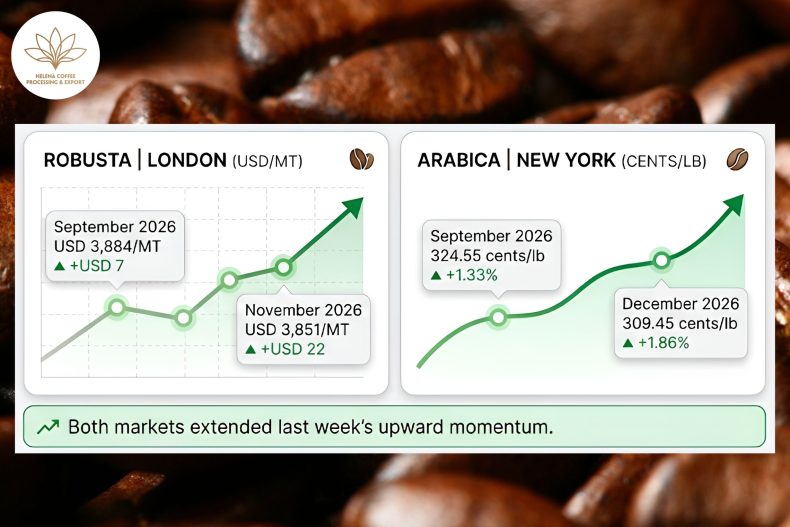
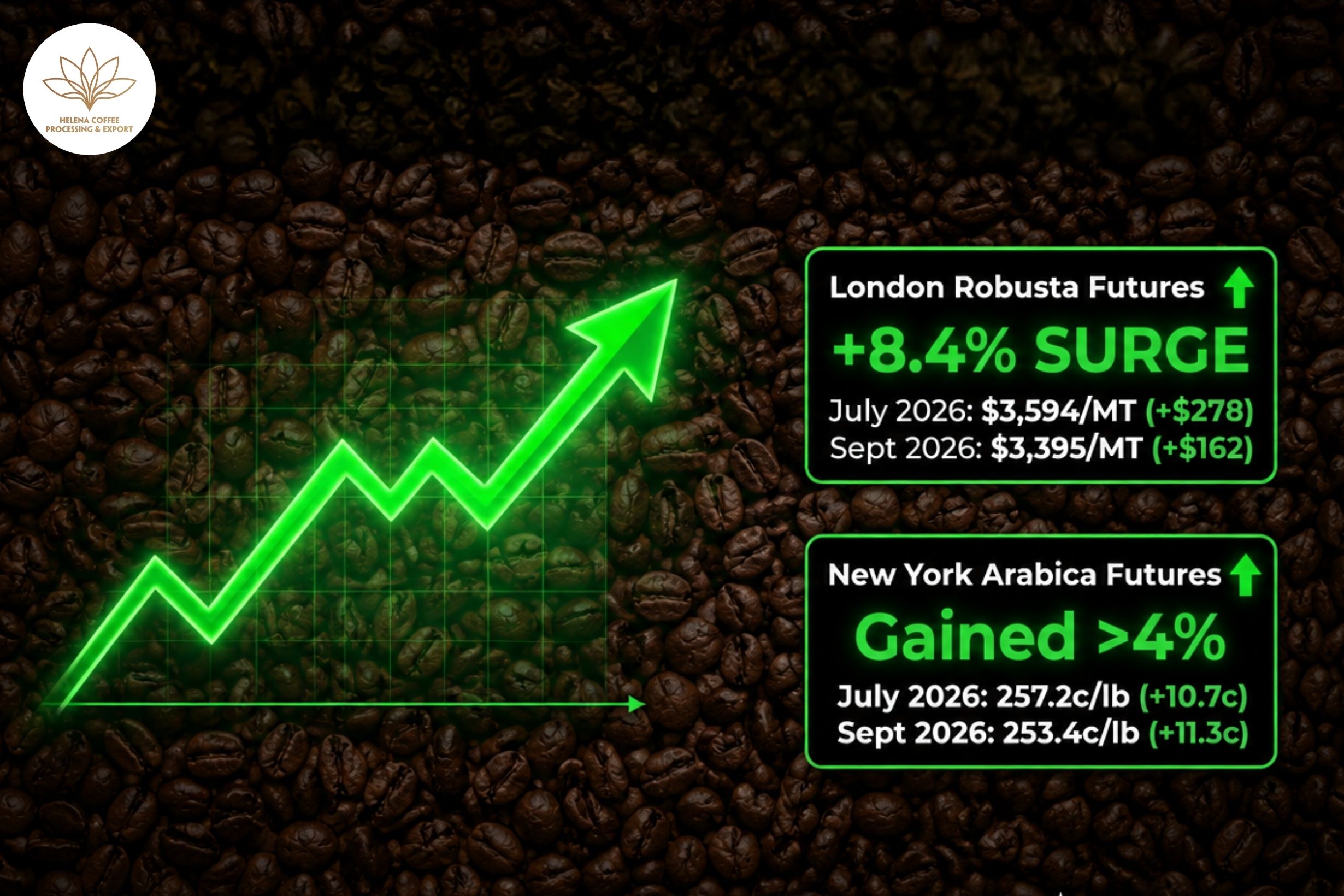
On the London exchange, robusta coffee prices for the July 2026 contract rose sharply by 8.4%, or US$278 per ton, reaching US$3,594 per ton. The September 2026 contract also gained 5%, equivalent to US$162 per ton, closing at US$3,395 per ton.
Similarly, on the New York exchange, arabica coffee prices for July 2026 increased by 4.3%, or 10.7 US cents per pound, reaching 257.2 US cents/lb. The September 2026 contract climbed 4.7%, or 11.3 US cents/lb, to 253.4 US cents/lb.
The rally marks a significant recovery after several weeks of downward pressure driven by expectations of stronger supply from Brazil and other major producing countries.

El Niño Becomes a Key Driver of Coffee Prices
Weather conditions have once again become the primary focus of the global coffee market. Several international sources, including the Japan Meteorological Agency, have confirmed that an El Niño pattern is developing in the equatorial Pacific region.
El Niño is often associated with extreme weather events such as droughts, flooding, and significant temperature fluctuations, which can impact coffee-growing regions across Asia and South America.
For the coffee market, these weather-related risks are especially important because they can directly affect yields, bean quality, and future production levels. As a result, many market participants returned to buying positions after recent sell-offs, helping drive coffee prices significantly higher last week.
Brazilian Growers Express Concerns About New Crop Quality
In addition to weather concerns, reports from Brazil have provided further support for global coffee prices.
According to sources from key producing regions such as Sul de Minas Gerais and Mogiana Paulista, many coffee farmers are expressing concerns about bean size in the new harvest.
However, industry experts caution that it is still too early to make definitive assessments regarding overall crop quality, as the 2026 arabica harvest remains in its early stages.
As the world’s largest coffee producer and exporter, any change in Brazil’s production outlook has the potential to significantly influence global coffee prices.
Peru Maintains Stable Coffee Production Outlook
Alongside Brazil, Peru is attracting increasing attention from market participants.
Coffee production is forecast to reach 4.78 million 60-kg bags, nearly unchanged from the 4.76 million bags estimated for the 2025/26 season.
Exports are projected at 4.55 million 60-kg bags, also relatively stable compared to the previous year, supported by steady supply and continued demand for high-quality Arabica coffee and certified coffee products.
Domestic consumption is estimated at 305,000 60-kg bags.
Coffee Area and Tree Numbers Continue to Expand
USDA data also indicates moderate growth in Peru’s coffee sector.
Harvested coffee area for the 2026/27 season is expected to reach 340,000 hectares, representing an increase of approximately 1% compared to the previous season.
The number of productive coffee trees is estimated at 630 million, while the total coffee tree population is expected to reach approximately 668 million trees.
Arabica remains Peru’s dominant coffee variety, with Typica and Caturra accounting for the majority of production.
Most Peruvian coffee farms remain small-scale operations of less than 5 hectares, relying on traditional farming methods such as shade-grown cultivation, hand-picking, and natural sun-drying.
While these practices contribute to coffee quality, they can also limit mechanization and large-scale expansion.
Ongoing Challenges for Peru’s Coffee Industry
Despite stable production forecasts, Peru’s coffee industry continues to face significant challenges.
One of the most pressing issues is limited access to credit. Land ownership complications often prevent farmers from obtaining formal financing, forcing many to rely on informal lenders or coffee buyers for financial support.
As a result, many producers join cooperatives to improve market access, receive technical assistance, and secure better prices for their coffee.
Infrastructure also remains a major obstacle. Weak transportation networks and insufficient storage facilities continue to reduce Peru’s competitiveness in the global coffee market.
Coffee Diseases Continue to Threaten Production
Beyond infrastructure and financing challenges, Peru’s coffee sector is still dealing with long-term disease pressures.
Coffee leaf rust, which first became a major issue in 2013, currently affects nearly 40% of the country’s coffee-growing area. Ongoing phytosanitary programs and tree replacement initiatives aim to reduce its impact.
Meanwhile, the coffee berry borer, first reported in 2020, remains a persistent threat, particularly in regions located below 1,500 meters above sea level.
These factors highlight that global coffee supply remains vulnerable despite generally positive production forecasts from major producing countries.

Outlook for Coffee Prices
The direction of coffee prices in the coming weeks will largely depend on weather developments, harvest progress in Brazil, and production prospects across major coffee-producing regions.
The emergence of El Niño has increased market concerns, while uncertainty surrounding bean quality in Brazil has provided additional support for prices.
Nevertheless, analysts advise market participants to closely monitor weather conditions and updated crop reports before making major decisions, as the coffee market remains highly volatile and sensitive to global supply developments.
As climate risks continue to influence agricultural commodities, coffee prices are likely to remain closely tied to weather forecasts and production expectations throughout the remainder of 2026.
Helena Coffee Vietnam – Your Trusted Green Coffee Partner
As global coffee prices continue to fluctuate, securing a reliable coffee supply has never been more important. Helena Coffee Vietnam supplies premium Vietnamese green coffee, including Robusta, Arabica, Excelsa, and specialty coffees, sourced directly from trusted farming regions. With stable quality, transparent sourcing, and competitive export solutions, Helena helps roasters and importers build a resilient and sustainable coffee business.
👉 Visit www.helenacoffee.vn or Info@helenacoffee.vn to explore our products and request a direct quote today!
Frequently Asked Questions (FAQ)
Q1. Why did coffee prices increase this week?
Coffee prices increased due to concerns about the developing El Niño weather pattern, uncertainty surrounding crop quality in Brazil, and renewed buying activity by traders.
Q2. How does El Niño affect coffee production?
El Niño can cause droughts, excessive rainfall, and temperature fluctuations that may reduce coffee yields and impact bean quality.
Q3. Which coffee type gained the most last week?
Robusta coffee recorded stronger gains than Arabica, with London futures rising more than 8% during the week.