Above 31.1 °C and 73 atm, carbon dioxide stops behaving like an ordinary gas. The UC Davis ChemWiki page on removing caffeine from coffee describes it as part gas, part liquid, and with water as a co-solvent it dissolves caffeine selectively. That single property is what CO2 decaf coffee is built on.
Buyers meet it as two words on a specification sheet, “CO2 process”, and want to know how such a lot compares with sugarcane and water process decaf. This guide explains the CO2 process for that comparison. Helena Coffee Vietnam’s green range, DC01 Robusta and DC02 Decaf Arabica, has at least 97% of the caffeine removed.
What “supercritical” means in supercritical CO2 decaffeination
“Supercritical” means held above both the critical temperature and the critical pressure, which for carbon dioxide are the 31.1 °C and 73 atm above. In that state the CO2 moves through a bean like a gas and dissolves caffeine like a liquid.
S. N. Katz, writing in Clarke and Macrae’s Coffee: Technology (1987), describes CO2 as a chemically stable, inert gas compressed until it dissolves caffeine. Plants use it in a closed cycle, so the same charge of gas goes round the system again and again.
Where the CO2 process came from
The route goes back to a 1970 patent held by Studiengesellschaft Kohle of Mulheim, Germany, and HAG-GF was the company that put it into commercial use in Germany. By the 1980s Katz could list supercritical carbon dioxide alongside methylene chloride, ethyl acetate and coffee oil among the commercial decaffeination solvents. The longer story of decaf, from the 1905 Bremen patent onward, is told in who invented decaf coffee.
Inside the carbon dioxide decaf process
Katz describes the commercial route in a few lines, and almost every line carries a number.
| Bean preparation | Cleaned, steamed and wetted to 30 to 50% moisture |
|---|---|
| Vessels | Extractor loaded with the wet beans; adsorber loaded with activated carbon |
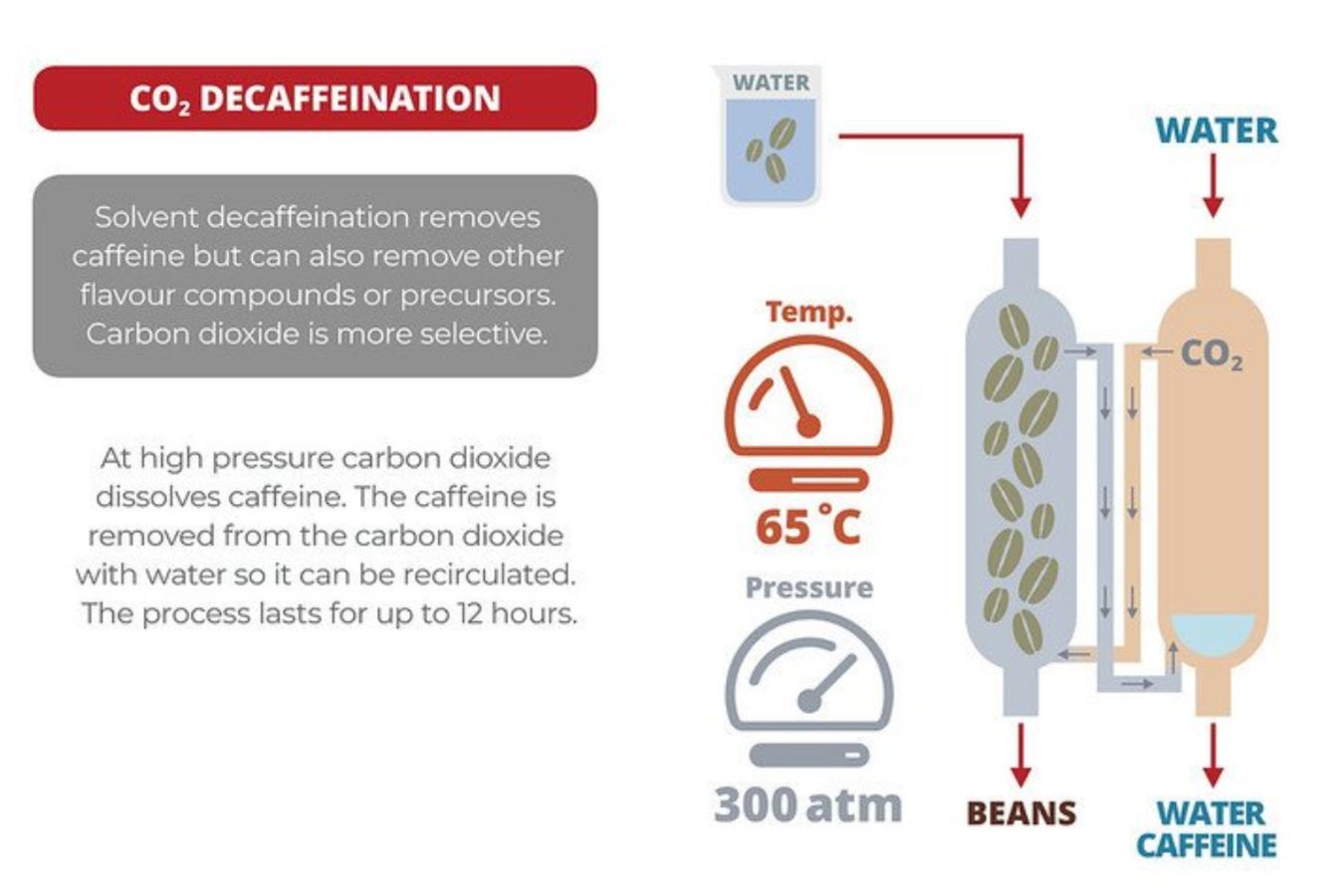
| Working fluid | Moist CO2 circulating at 40 to 80 °C and 120 to 180 bar |
| Caffeine path | From the beans into the CO2, then onto the carbon |
| Gas | Recirculated in a closed cycle |
| Finishing | Beans dried to about 10% water |
| Caffeine removed | About 97% (UC Davis ChemWiki) |
Two details explain the numbers. The beans go in wet, at 30 to 50%, because Katz’s moisture rule for solvent decaffeination applies here as well: a bean under about 20% water gives up little caffeine whatever the volume of solvent, as the guide to sugarcane decaf coffee explains. And the CO2 is moist: UC Davis notes that water acts as its co-solvent.
In the plant Katz describes, the caffeine ends up on the carbon. The slide set “Decaffeination of Coffee Beans” adds a second way to strip it from the gas, rinsing with water, before the CO2 is recirculated, and gives about 70 °C as a working temperature, inside Katz’s range.
Selectivity: what CO2 decaf coffee keeps in the bean
Selectivity is the process’s strongest card. Katz notes that CO2 is very selective for caffeine, so the non-caffeine solids stay in the bean, and the UC Davis case study puts removal at about 97%.
Selectivity in the vessel does not settle the cup on its own. In James Hoffmann’s Decaf Project of December 2024, reported by Perfect Daily Grind, CO2, sugar cane ethyl acetate and a water process were run on the same coffee, and the roast profile mattered more than the method. A buyer comparing a CO2 offer with an EA or water lot learns more from roasting both well than from the method name.
Why CO2 plants run big batches
Katz names the drawback in one line: the high pressure means costly equipment and batch processing. Every run fills an extractor working at 120 to 180 bar, takes it through the cycle and empties it, and vessels that costly earn their keep only when they run full.
For a buyer of CO2 decaf coffee, those economics turn into practical questions: how large a load the processor’s vessel takes, whether a trial lot can be run on its own, and how the lot keeps its identity through the plant. Ask them before cupping samples: a lot that cannot be run at your volume is not a real option.
CO2 process decaf against sugarcane EA and water process
The table puts a CO2 lot beside sugarcane EA and water process lots.
| Point | Supercritical CO2 | Sugarcane EA | Water Process |
|---|---|---|---|
| What removes the caffeine | Moist CO2 at 120 to 180 bar | Ethyl acetate fermented from sugarcane | Hot water; activated carbon holds the caffeine |
| Where the caffeine goes | Onto activated carbon in an adsorber | Into the solvent washes; steam cleaning then removes the remaining EA | Onto activated carbon; the water returns flavour-charged |
| Caffeine figure | About 97% removed (UC Davis ChemWiki) | At least 97% removed | 99.9% caffeine free |
| Cup, as described | Non-caffeine solids stay in the bean (Katz) | Sweet, fruity notes kept | Clean, origin character |
| Run size | Batches in costly high-pressure vessels | Depends on the plant | Depends on the plant |
| Label wording | “CO2 process”, matching the method statement | “Sugarcane process” or “naturally decaffeinated”, checked locally | “Water Process”; “chemical free” if the importer confirms |
| Figure to ask for | Residual caffeine of the lot, by HPLC | Same | Same |
Read the caffeine row with care. The two 97% figures measure removal, which is how the US working benchmark is framed; “99.9% caffeine free” states what is left, at most 0.1%, which is how EU national rules frame decaffeinated roasted coffee (0.1% on dry matter).
Whatever the method, ask for the residual caffeine of the actual lot, measured by HPLC under ISO 20481, and for its moisture, which a dry-matter caffeine figure depends on.
What Helena ships: DC01 Robusta and DC02 Arabica
DC01 Decaf Robusta from Dak Lak and DC02 Decaf Arabica from Lam Dong are decaffeinated at a partner plant under Helena’s quality control, with at least 97% of the caffeine removed and the residual caffeine on every lot’s COA.
Each is Grade 1 green coffee in screens S18, S16 and S14 with moisture at 12.5% max, packed in 60 kg jute bags with GrainPro or PE liners, 30 or 60 kg vacuum packs or 1-tonne big bags.
Put Helena’s decaf next to your CO2 spec
If a CO2 lot is on your table today, cup it against Helena’s DC01 and DC02: samples of 50 to 100 g per type are free, the courier is charged to you and credited on the first order. Send your current specification, the volume and the port of discharge to info@helenacoffee.vn or WhatsApp +84 837 88 96 98; the quotation comes within 24 to 48 hours.
Frequently Asked Questions
What is CO2 decaf coffee?
Green coffee decaffeinated with carbon dioxide held above its critical point, 31.1 °C and 73 atm. In the commercial process the wetted beans sit in an extractor while moist CO2 at 40 to 80 °C and 120 to 180 bar carries caffeine to an activated-carbon adsorber in a closed loop.
How much caffeine does the CO2 process remove?
The UC Davis ChemWiki case study gives about 97%, a removal figure. Applied to the textbook’s round starting levels (Arabica about 1%, Robusta about 2%), that would leave roughly 0.03% and 0.06% caffeine respectively. For a real lot, the residual caffeine on the COA, measured by HPLC, is the number to use.
Is sparkling water decaf the same as CO2 decaf coffee?
The name points to the two fluids at work in the CO2 route, water and carbon dioxide: the beans are wetted to 30 to 50% moisture and the CO2 circulates moist. A retail name is not a method statement, though, so check that the specification sheet and COA name supercritical CO2 as the process.
Is CO2 decaf better than sugarcane or water process decaf?
There is no single ranking. Katz describes CO2 as very selective for caffeine, sugarcane EA is known for a sweet, fruity cup and the water process for a clean one with origin character, and in James Hoffmann’s side-by-side test, reported by Perfect Daily Grind, roasting mattered more than the method.
Why is CO2 decaffeination done in batches?
Because of the pressure. Moist CO2 works at 120 to 180 bar, and Katz notes that such pressure means costly equipment and batch processing: each extractor is loaded, run through the cycle and emptied. For buyers this makes the processor’s batch size an early question when planning a small or trial lot.