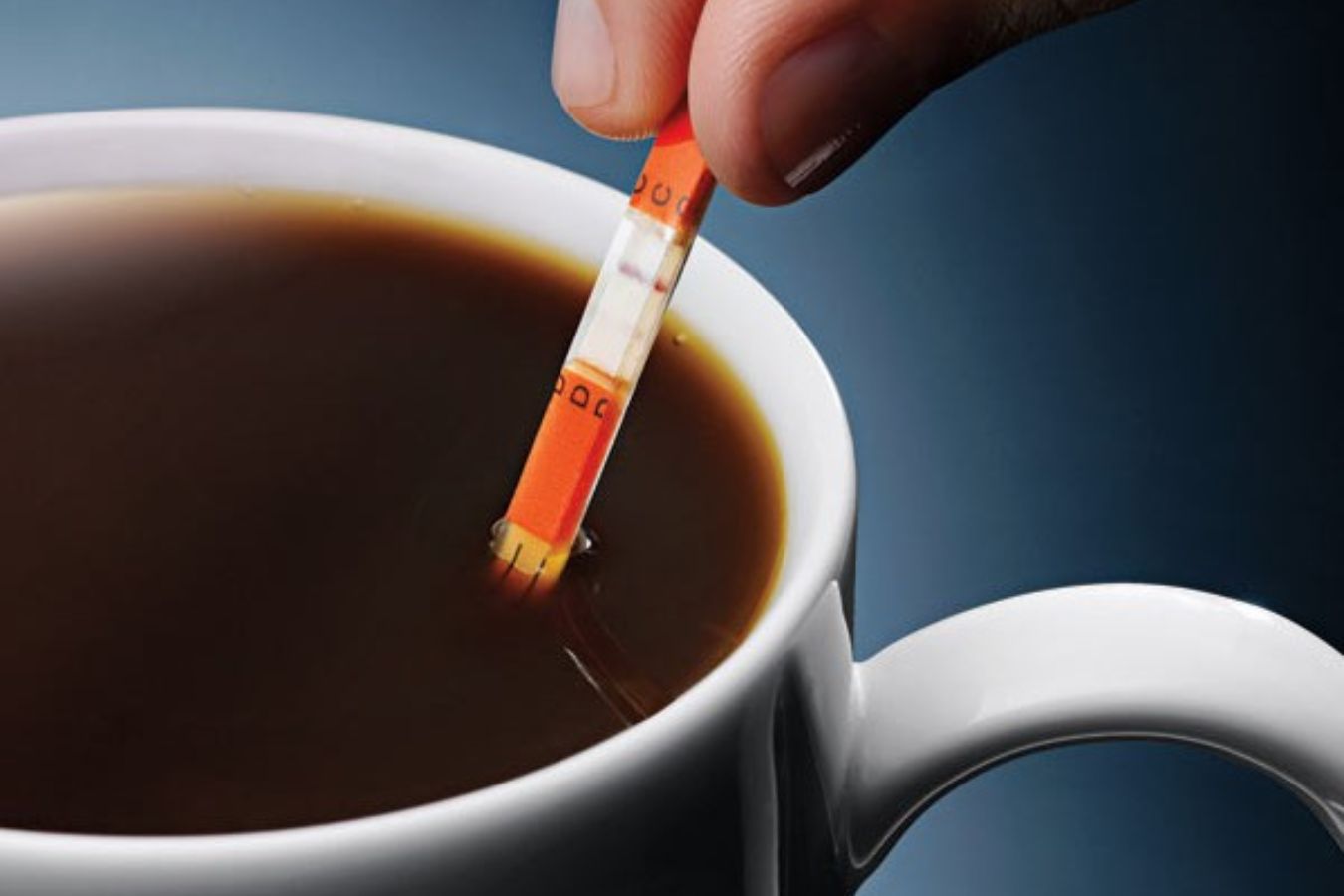
Slit open a 60 kg bag of sugarcane decaf coffee on the roastery floor and the first surprise is the colour: amber to yellow-brown, not green. The beans are also more brittle than the lot they came from. Both are normal marks of what the beans went through: steaming, washes in ethyl acetate, a second steaming and drying.
Helena Coffee Vietnam’s two green decaf products, including DC02 Decaf Arabica from Lam Dong, have at least 97% of the caffeine removed. This guide covers the four steps of the EA process with the reason for each, what “at least 97% removed” leaves in Arabica and Robusta, and the label words the paperwork can support.
What sugarcane decaf coffee is, and where the solvent comes from
Sugarcane decaf coffee is green coffee decaffeinated with ethyl acetate (EA) made from fermented sugarcane. Suppliers call it the Sugar Cane (EA) process, and roasters also list it as sugar cane process coffee or EA decaf: three names, one method.
The UC Davis ChemWiki case study on removing caffeine notes that ethyl acetate occurs naturally in fruits, hence the retail phrase “naturally decaffeinated”. Clarke and Macrae’s Coffee: Technology (1987) already lists it among the commercial decaffeination solvents of the 1980s.
It is a direct method: the solvent touches the bean. It works on green coffee because, as the book explains, flavour and aroma develop in the roaster, so removing caffeine first keeps flavour loss to a minimum. Decaffeination with water and activated carbon only is covered under water process decaf.
The EA decaf process in four steps, with the reason for each
The reasons for each step come from the decaffeination chapter by S. N. Katz of General Foods in Coffee: Technology and from a university handout on caffeine extraction.
| Step | What the plant does | Why it is there |
|---|---|---|
| 1. Steam | Steam opens the green bean’s surface. | Moisture softens and opens the cell structure so caffeine can move. |
| 2. Wash in sugarcane EA | Ethyl acetate made from fermented sugarcane binds to caffeine and draws it out of the bean. | Caffeine passes into the liquid in which it is more soluble. |
| 3. Repeat, then steam clean | Many wash cycles, then steam removes the remaining EA. | Several small washes extract more than one large one; steam strips the solvent back out. |
| 4. Dry | The beans are dried back to standard green-bean moisture. | Green coffee ships dry: 12.5% moisture max on a typical specification. |
Why water must be in the bean before the solvent
Katz puts the minimum bean moisture for solvent decaffeination at about 20%: below it, little caffeine comes out however much solvent is used. Plants work at up to 55%, which is saturation.
Water opens the cell structure so caffeine can diffuse out, and it frees the caffeine that is bound to chlorogenic acid as potassium chlorogenate, a complex that a non-polar solvent cannot dissolve. In his typical process, about half an hour of steam brings the beans to 16 to 18% moisture and pre-wetting takes them above 40%.
Why many short washes beat one long one
Caffeine divides between two liquids according to a partition coefficient, favouring the one in which it is more soluble. The CH241 laboratory handout on caffeine extraction draws the consequence: several small washes with fresh solvent extract more than one large wash.
Plants apply the same rule at scale. Katz describes counter-current extraction in a battery of columns at 50 to 120 °C until 95 to 98% of the caffeine is removed, which is why step three of the process runs many cycles, not one long soak.
What “at least 97% removed” leaves in Arabica and Robusta
Helena’s specification for DC01 and DC02 states at least 97% of caffeine removed: a removal figure, the yardstick of the US working benchmark. Other markets use a residual figure: EU national rules, Germany’s for example, cap decaffeinated roasted coffee at 0.1% caffeine on dry matter.
The two yardsticks treat the species differently because the starting points differ. With the round figures in Coffee: Technology, Arabica about 1% caffeine and Robusta about 2%, the arithmetic runs as follows.
| Figure | Arabica | Robusta |
|---|---|---|
| Caffeine in the untreated bean (book’s round figure) | about 1% | about 2% |
| Caffeine in 1 kg of green coffee | about 10 g | about 20 g |
| Left after 97% removal | about 0.03%, or 0.3 g per kg | about 0.06%, or 0.6 g per kg |
| Left after 90% removal, for contrast | about 0.1% | about 0.2% |
These rows are arithmetic from the book’s round numbers, not Helena lot results; each lot’s COA carries its residual caffeine measured by HPLC under ISO 20481, explained in how to test caffeine in coffee. The last row is why Robusta buyers read the removal level closely: at 90% removal, a 2% bean still holds about twice a 0.1% limit. Limits by destination are compared in decaf coffee regulations by country.
Cup profile: what sugarcane decaf coffee keeps, and who buys it
The sugarcane decaf cup is usually summed up as sweet, with fruity notes kept. Some change is unavoidable: the laboratory handouts point out that caffeine itself tastes slightly bitter, so a bean without it cannot taste exactly like the original.
The typical buyer is a specialty roaster who wants a decaf that stands on its own: a single-origin decaf line, a filter decaf sold on its fruit, or an espresso decaf whose sweetness must carry through milk. Decaf now competes too: Perfect Daily Grind reported that a decaffeinated Typica from Colombia won the 2024 US Brewers Cup.
Roasting gets one line here: these less dense, more brittle beans need their own profile, covered in roasting decaf coffee.
“Naturally decaffeinated coffee”: the rules and the label wording
In the United States, 21 CFR 173.228 allows ethyl acetate as a solvent in the decaffeination of coffee and tea under good manufacturing practice. In the EU, Directive 2009/32/EC lists it among the extraction solvents allowed on the same basis. For any other destination, the importer confirms the current requirement before the first shipment. Other solvents raise their own questions, covered in methylene chloride decaf.
Permission and label wording are separate questions. A claim such as “sugarcane process”, “ethyl acetate process” or “naturally decaffeinated” must match the method statement on the specification sheet and COA of the lot in the bag, and changes if a later lot is bought in another method. The importer checks locally whether a market accepts “natural” on a retail pack.
Helena’s green decaf lots: DC01 Robusta and DC02 Arabica
Helena offers DC01 Decaf Robusta, 100% Robusta from Dak Lak, and DC02 Decaf Arabica from Lam Dong, both decaffeinated at a partner plant under Helena’s quality control.
| Grade and screens | Grade 1; S18 (7.1 mm), S16 (6.3 mm) or S14; more than 90% on the stated screen |
|---|---|
| Moisture | 12.5% max |
| Admixture | 0.1% max (S14: 1% max) |
| Black and broken | 0.5 to 1% max |
| Caffeine | At least 97% removed; residual measured by HPLC (ISO 20481) on each COA |
| Packing | 60 kg jute bags with GrainPro or PE liner; vacuum packs of 30 or 60 kg; 1-tonne big bags |
| One 20 ft container | 320 bags of 60 kg, 19.2 tonnes |
R. J. Clarke notes in Coffee: Technology that caffeine is not normally part of a green coffee specification except for decaf, where moisture should be known too: here the specification carries the moisture limit and the COA the caffeine result. Trial lots and container loads are quoted case by case, and decaffeination runs are scheduled per booked lot.
Next step: cup a Helena lot beside your current decaf
Request 50 to 100 g of DC01 or DC02: the sample is free, and the courier cost you pay is credited on your first order. Send the screen, volume and destination port by WhatsApp to +84 837 88 96 98 or to info@helenacoffee.vn for a quotation within 24 to 48 hours.
Frequently Asked Questions
What is sugarcane decaf coffee?
It is green coffee decaffeinated with ethyl acetate made from fermented sugarcane: steamed, washed in the solvent over many cycles, steam cleaned and dried. The name describes the source of the solvent; none of the four steps adds sugar to the bean.
Is sugar cane process coffee the same as ethyl acetate decaf?
It is ethyl acetate decaf in which the solvent is made from fermented sugarcane. Under either name, ask the supplier for the grade and screen, a specification sheet that names the method and a COA that covers that exact lot.
How much caffeine is left in sugarcane decaf coffee?
It depends on the removal level. On the round figures in Coffee: Technology, at least 97% of the caffeine removed leaves about 0.03% in Arabica and 0.06% in Robusta. These are illustrations; a real lot’s residual caffeine is the HPLC result (ISO 20481) on its COA.
Is ethyl acetate decaf allowed in the EU and the United States?
Both markets have written permissions. The US rule, 21 CFR 173.228, covers ethyl acetate for decaffeinating coffee and tea under good manufacturing practice; the EU’s Directive 2009/32/EC lists it among permitted extraction solvents. Elsewhere, the importer confirms the rule in force before the first shipment.
Can Robusta be decaffeinated with the sugarcane EA process?
Yes. Robusta starts with about twice Arabica’s caffeine, so for a market with a 0.1% residual rule, read the residual figure on the COA, not just the removal percentage.