Vietnam is strengthening its position in the international coffee industry, moving beyond its traditional role as a major green coffee supplier. With growing investments in manufacturing technology and processed products, the country is becoming an increasingly important player in the global instant coffee market. According to information presented at the Vietnam International Coffee Conference 2026 (VICO 2026), Vietnam has surpassed Brazil to become the world’s leading exporter in this category, marking a significant milestone for its coffee industry.
Vietnam Reaches the Top of the Global Instant Coffee Market
During the 2025–2026 crop year, Vietnam accounted for 14.2% of global instant coffee export market share, compared with 11.2% for Brazil. Other major exporting countries included Germany (8.9%), Spain (6.7%), Mexico (5.9%), Malaysia (5.3%), and India (5%).
These figures, shared by Vanúsia Nogueira, Executive Director of the International Coffee Organization (ICO), at VICO 2026 in Ho Chi Minh City, highlight the growing competitiveness of Vietnamese manufacturers.
The country’s strong Robusta production base provides an important advantage for industrial processing. Combined with expanding factory capacity, established sourcing networks, and increasing international demand, Vietnam is developing a stronger role in supplying soluble coffee products to global buyers.
According to Do Ha Nam, Vice Chairman of the Vietnam Coffee and Cocoa Association (VICOFA), many domestic factories supplying materials for instant coffee production have already secured orders expected to keep their facilities operating at full capacity through the first quarter of 2027.
This demand reflects the growing importance of Vietnam as a sourcing destination for international food and beverage manufacturers.
Deep Processing Creates Greater Value for Vietnamese Coffee
For many years, Vietnam’s coffee industry was primarily associated with green Robusta beans exported to international trading companies and roasting businesses. Today, the industry is gradually expanding into higher-value manufacturing.
According to figures presented at VICO 2026, processed coffee exports reached approximately 142,600 metric tons during the 2025–2026 crop year, generating an estimated USD 1.5 billion in export revenue. This represented an increase of around 15% in volume and 14% in value compared with the previous crop year.
Furthermore, processed coffee exports surpassed USD 1 billion in 2025, demonstrating the growing contribution of manufacturing to the national coffee economy.
This transformation is encouraging domestic enterprises and foreign-invested companies to expand their factories, upgrade production equipment, and introduce new product lines.
For international buyers, this creates more sourcing possibilities. Instead of purchasing only raw materials, importers can increasingly access finished coffee products, customized formulations, and ingredients suitable for food manufacturing, beverage production, and retail distribution.
Spray-Dried and Freeze-Dried Coffee: Understanding the Difference
Processing technology plays a central role in determining product characteristics, manufacturing costs, and market positioning.
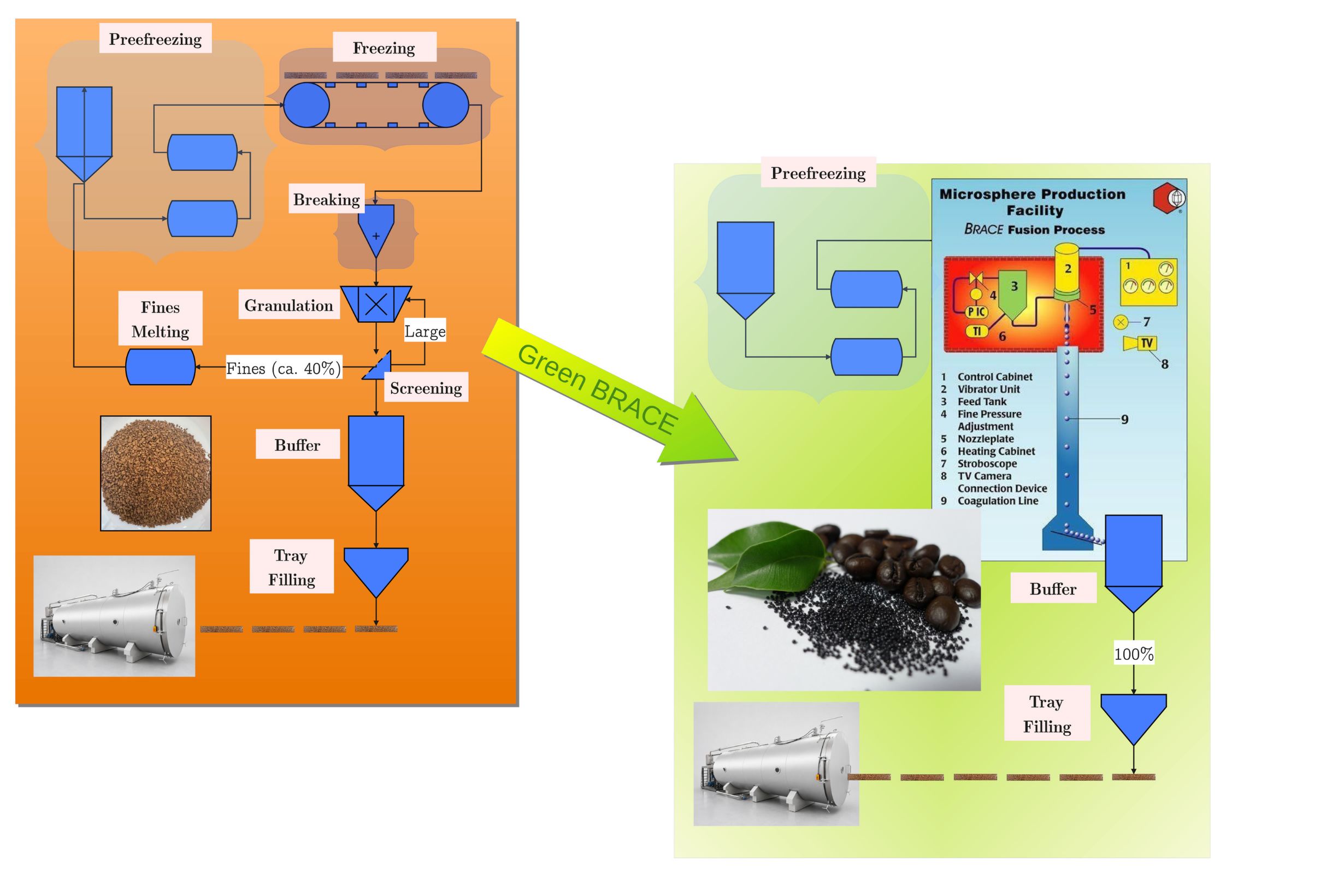
Spray-Dried Coffee (SD) is manufactured by spraying concentrated coffee extract into hot air, rapidly removing moisture to produce soluble coffee powder. It is widely used in mass-market applications because of its efficient production process, scalability, and competitive cost structure.
Freeze-Dried Coffee (FD) follows a different method. The coffee extract is frozen before water is removed through vacuum sublimation. This process creates recognizable granules and helps retain desirable aroma and flavor characteristics.
At VICO 2026, Nguyen Hoang Phu, representing Rieckermann, highlighted the rapid growth in demand for freeze-dried products. Current demand reportedly exceeds the production capacity of Vietnamese manufacturers, partly because large-scale industrial facilities remain limited.
This situation creates an attractive opportunity for investment in modern processing infrastructure. Manufacturers with the ability to deliver consistent specifications, reliable production volumes, and suitable packaging solutions may gain a stronger position in the premium segment.
For importers and beverage companies, understanding these technologies is essential when selecting products for different consumer groups and price categories.
Asia-Pacific Is Becoming a Major Coffee Consumption Hub
Production is only one part of the global coffee market. Changes in consumer behavior are equally important in shaping future trade opportunities.
According to information shared by the ICO at VICO 2026, Europe’s share of global coffee consumption declined from 35% in the 2010–2011 crop year to 31% in 2025–2026.
Meanwhile, Asia-Pacific increased its share from 19% to 27% over the same period.
This development reflects changing lifestyles, urbanization, and growing interest in convenient beverage options. In markets such as Russia, Japan, and Australia, soluble coffee already represents an important part of consumer demand.
With its large population and expanding middle class, Asia-Pacific is expected to remain a major driver of global coffee consumption.
For Vietnamese manufacturers, this creates opportunities to develop market-specific products, strengthen distribution networks, and establish direct relationships with international importers and beverage brands.
What International Buyers Should Consider When Sourcing from Vietnam
As the country’s processing industry expands, international buyers have more opportunities to diversify their supply chains. However, selecting a suitable supplier requires more than comparing prices.
Important considerations include:
- Product consistency: Moisture levels, solubility, aroma, flavor, and product specifications.
- Manufacturing capacity: Reliable production schedules and the ability to fulfill bulk orders.
- Quality assurance: Appropriate testing procedures, product documentation, and food safety standards.
- Packaging flexibility: Bulk packaging, retail formats, and customized private-label solutions.
- Export experience: Professional communication, shipping coordination, and export documentation.
These factors help importers establish stable sourcing relationships and reduce uncertainty throughout the purchasing process.
Helena Coffee: Connecting Vietnamese Coffee with International Buyers
At Helena Coffee, we believe that the future of Vietnam’s coffee industry depends on combining quality origins, processing capabilities, and reliable international partnerships.
From Robusta and Arabica green beans to roasted coffee and processed coffee solutions, Vietnam offers a diverse range of products for international importers, roasters, distributors, and beverage manufacturers.
As global demand continues to evolve, the country’s transition toward higher-value production represents an important opportunity for businesses seeking new sourcing partners in Southeast Asia.
Helena Coffee aims to connect Vietnamese coffee origins with international markets through professional sourcing, product development, and export cooperation.
Vietnamese Coffee – From Origin to Global Value.
Looking for a reliable coffee supplier from Vietnam? Contact Helena Coffee to discuss your sourcing requirements and explore long-term B2B cooperation opportunities.
For additional industry information, visit the International Coffee Organization (ICO).