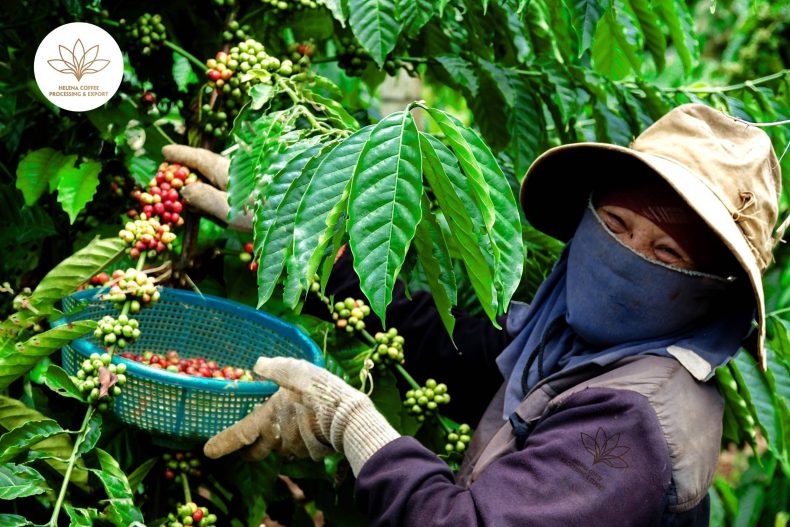
Vietnam is one of the world’s leading coffee producers and exporters, especially known for its Robusta. While the industry has long focused on high-volume, low-cost production, recent years have seen a shift toward quality, sustainability, and value-added products.
Challenges such as climate change, market volatility, and rising input costs are pushing farmers and producers to adopt more resilient farming practices and invest in post-harvest processing. At the same time, interest in specialty coffee and traceable supply chains is growing, marking a positive transformation in Vietnam’s coffee sector.
In this article, we’ll explore the main coffee varieties grown in Vietnam, their characteristics, and where they thrive best.
Robusta Coffee (Coffea canephora) – The Most Widely Grown Variety in Vietnam
Robusta coffee, locally known as “cà phê Vối”, accounts for more than 90% of Vietnam’s total coffee cultivation area and is prized for its bold flavor and high caffeine content—ideal for instant coffee and espresso blends. This variety is favored for its resilience and high productivity:
Tree height: 7–8 meters, bushy or woody form.
High caffeine content: 2–4%, strong bitter flavor.
Ideal growing altitude: 400–1,200 meters.
Requires average temperatures of 24–30°C and over 1,000mm of annual rainfall.
Grows well in full sunlight and rich basaltic soils, such as those in the Central Highlands.
Robusta is primarily cultivated in provinces like Dak Lak, Gia Lai, Lam Dong, and Dak Nong, making it the economic backbone of Vietnam’s coffee industry.

Arabica Coffee (Coffea arabica) – High Value, Limited Cultivation
Arabica, known in Vietnam as “cà phê Chè”, covers around 10% of the total coffee area .Vietnamese Arabica is celebrated for its delicate aroma, bright acidity, and complex flavor profile — often described as smooth, fruity, and floral. Despite its limited cultivation, it is prized for its exceptional cup quality:
Tree height: up to 6 meters, smaller leaves, often pruned to look like tea plants.
Caffeine content: 1–2%, smooth body, sweet aroma, less bitterness.
Ideal growing altitude: 1,000–2,000 meters.
Prefers cooler climates (16–25°C) with high rainfall (over 2,000mm).
Sensitive to pests and diseases, requires shaded environments.
Arabica is grown in highland regions like Cau Dat (Lam Dong), Khe Sanh (Quang Tri), Son La, and Dien Bien. The most common cultivar is Catimor, a hybrid that’s easier to grow but slightly lower in quality compared to traditional Typica or Bourbon.

Excelsa Coffee (Coffea excelsa) – A Lesser-Known Specialty
Excelsa, often referred to as “cà phê Mít” in Vietnam, accounts for just about 1% of total coffee cultivation.This rare coffee is often described as having flavours of dark berries, sour citrus and mysterious earthiness. For those looking for something truly different, Excelsa offers a fascinating journey into the richness and diversity of Vietnam’s coffee heritage. However, it holds niche appeal:
Tree height: over 10 meters, large leaves, late-ripening fruits.
Caffeine content: about 2%, tangy and fruity flavor.
Ideal for altitudes below 800 meters, average temperatures of 26–30°C.
Low maintenance, naturally pest-resistant.
This variety is typically grown in lower altitude areas and is often used for blending or experimental roasts.
Liberica Coffee (Coffea liberica) – Rare and Unique
Liberica coffee, sometimes confused with Excelsa and also locally called “cà phê Mít”, is truly a rare gem in the coffee world. Known for its large beans and unique floral, smoky aroma, Liberica offers a bold and full-bodied cup unlike any other. Its distinctive flavor carries hints of dark chocolate, ripe fruit, and a subtle woody undertone, making it a favorite among coffee connoisseurs seeking something extraordinary. Liberica is now rarely grown in Vietnam:
Tree height: very tall, large leaves, late ripening.
Grows best below 600 meters.
Distinctive sour taste, appreciated in European blends.
Liberica originated in West Africa (Liberia, Sierra Leone), and small-scale planting was once reported in Buon Ma Thuot, Dat Ly, and Ea Pok, but it’s now uncommon in Vietnam.

Why Choosing the Right Coffee Variety Matters
Understanding the different coffee varieties in Vietnam and their ideal growing conditions is key to achieving both high yield and quality. Introducing a new variety to a region requires careful selection, adaptation trials, and scientific support. Arbitrary planting without proper planning can lead to poor results.
Want to Learn More About Vietnamese Coffee?
Follow Helena Coffee for daily insights and useful knowledge about coffee varieties, roasting, and brewing techniques. Whether you’re a grower, roaster, or coffee lover – we’ve got something valuable for you every day!
📩 Contact us today to request samples or pricing:
🌐 Website: www.helenacoffee.vn
📧 Email: info@helenacoffee.vn