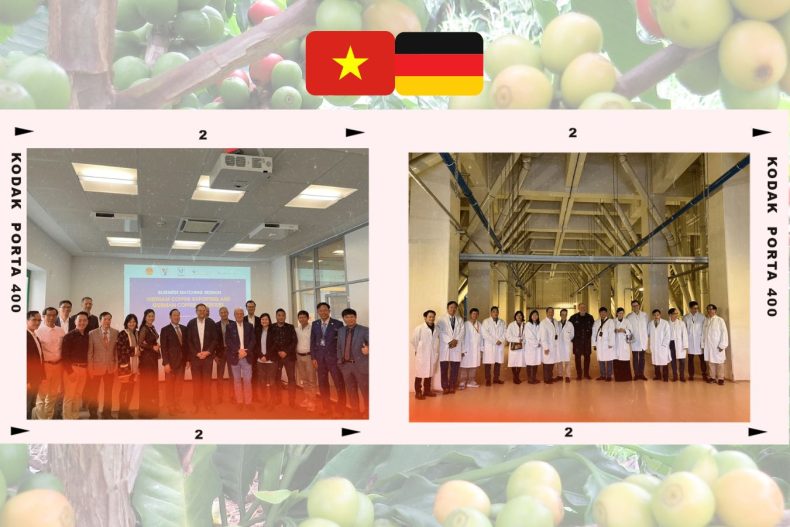
Despite strong export growth to the United States in early 2025, Europe remains the cornerstone of Vietnamese coffee exports. With a stable demand, favorable trade agreements, and a preference for Robusta – Vietnam’s specialty – Europe continues to play a pivotal role in sustaining the growth and global positioning of Vietnamese coffee.
Coffee Prices See Fluctuations, But Exports Keep Rising
As of late June 2025, domestic coffee prices in Vietnam fell by around VND 30,000/kg compared to the previous month, ranging from VND 93,500 to 93,800/kg depending on the region. By July 5, prices showed a modest recovery, increasing by VND 800/kg, with the highest price recorded in Dak Lak (VND 96,300/kg) and the lowest in Lam Dong (VND 95,800/kg).
According to the Ministry of Agriculture and Environment’s Digital Transformation Department, Vietnam exported approximately 953,900 tonnes of coffee in the first half of 2025, generating USD 5.45 billion – a 67.5% increase in value compared to the same period last year. The average export price reached USD 5,708/tonne, up 59.1% year-over-year.
Global Oversupply Puts Pressure on Prices
The June 2025 report from the U.S. Department of Agriculture (USDA) estimates global coffee production for the 2025–2026 season will hit a record 178.7 million bags (60 kg each) – an increase of 4.3 million bags over the previous crop year. This growth is driven mainly by Vietnam, Indonesia, and Ethiopia, with the latter hitting its highest output ever.
USDA also forecasts green coffee exports will increase by 700,000 bags to 122.3 million, while global consumption is expected to reach only 169.4 million bags. This results in a 9.3 million bag surplus, creating downward pressure on prices.
Adding to this, favorable weather in Brazil and depreciating local currencies in top exporters like Vietnam and Brazil have made coffee even cheaper in U.S. dollar terms, further affecting global price stability.

The U.S. Market Isn’t the Primary Driver Yet
Although exports to the U.S. surged in early 2025 – with nearly 299 million USD in revenue in the first five months, a 76.4% increase over the same period last year – the U.S. still does not represent Vietnam’s main coffee export market.
Moreover, concerns have been rising over a proposed 20% U.S. import tax on Vietnamese coffee. While this is a reduction from a previous 46%, it still doubles the 10% tariff applied to Brazil – Vietnam’s closest competitor – which enjoys better logistics and similar Robusta output (estimated at 26–27 million bags in 2025).
In response, many Vietnamese coffee exporters are pivoting toward Europe, where trade frameworks are more favorable and demand remains stable.
Europe Accounts for 80% of Vietnam’s Coffee Exports
Germany: 16.3%
Italy: 7.9%
Spain: 7.4%

Why Europe Remains a Stronghold for Vietnamese Coffee
1. Strong demand for Robusta: European coffee roasters and processors rely heavily on Robusta, which aligns with Vietnam’s export strengths.
2. Trade advantages via EVFTA: The EU-Vietnam Free Trade Agreement allows many Vietnamese coffee products to enjoy lower tariffs, easing export procedures and improving profitability.
3. Market familiarity and logistics: Vietnamese exporters have built long-term relationships with European partners, and their products already meet EU standards in quality, traceability, and environmental compliance.
With growing uncertainty in the U.S. market, Europe presents a more predictable and lucrative alternative for scaling exports.
Quality and Transparency: Keys to Long-Term Growth
To maintain and expand their footprint in the European market, Vietnamese coffee exporters must continue investing in:
Stable, traceable supply chains
Compliance with EU environmental and social standards (e.g. EUDR)
Higher value products such as instant, roasted, and specialty packaged coffee
Strong branding and marketing strategies that position Vietnamese coffee as high-quality and sustainable

Conclusion: Europe Is the Backbone of Vietnamese Coffee Exports
In the global race for market share, Europe remains the foundation of Vietnam’s coffee export strategy. While emerging markets like the U.S. show promise, policy risks and trade barriers make Europe a safer, more consistent outlet for long-term growth.
With a combination of product quality, strategic trade deals, and growing brand recognition, Vietnamese coffee is poised to thrive in the European market, even amid global challenges.
By deepening their presence in Europe and continuing to innovate, Vietnamese coffee producers can secure their global position, promote sustainable growth, and elevate Vietnam’s image as one of the world’s premier coffee suppliers.
Helena Coffee – Empowering Vietnamese Coffee to Thrive in the European Market
With years of experience exporting high-quality green and instant coffee, Helena Coffee Vietnam is proud to be a trusted partner for roasters and importers across Europe. We don’t just deliver products that meet international standards — we also provide tailored consulting and market-specific solutions to help our clients optimize their supply chains and grow sustainably.
👉 Visit www.helenacoffee.vn or Info@helenacoffee.vn to explore our products and request a direct quote today!